Full · 6 min aloud
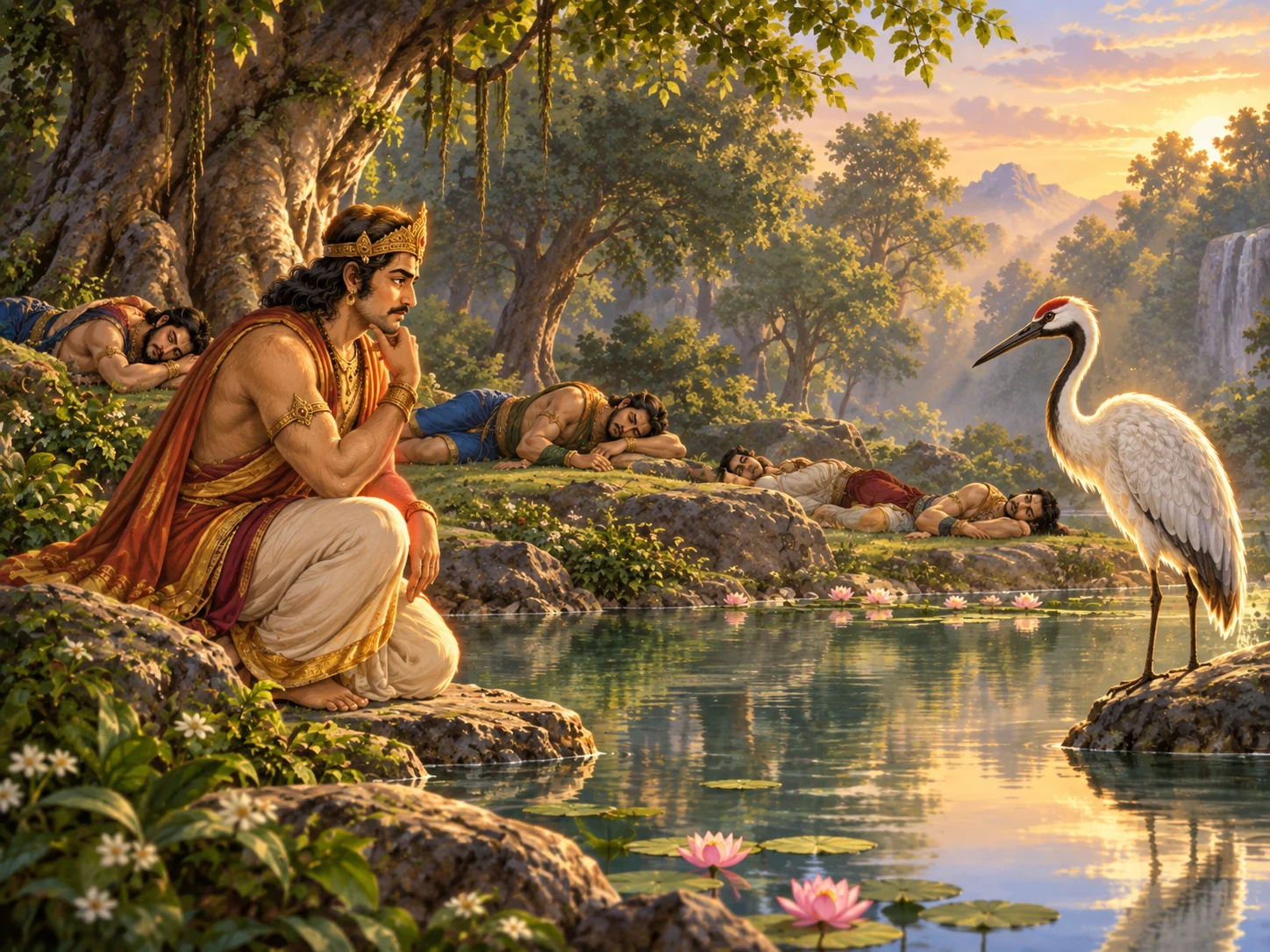
Five brothers in a forest, deep into an exile that had years left in it, and no water anywhere.
, the youngest, went to look, and found a lake. Clear, cold, completely still. He knelt down.
And a voice said: this water is mine. Answer my questions, and then drink.
He drank. And he fell down beside it and did not get up.
went after him.
He came through the trees and saw his brother lying on the bank, and the lake beside him, and — this is the part to notice — he went to the water first.
The voice said the same thing to him. He drank, and he fell.
Then went, and found two of them. Then went, and found three. Each of them was told. Each of them drank.
came last.
He found all four brothers on the ground beside a lake that looked perfectly safe. None was marked. None was breathing.
He was as thirsty as any of them had been. He had walked further.
He did not drink. He said: ask.
There was a on the bank in the shape of a crane, and it asked him question after question. answered without reaching for the water, even though his thirst had not gone away.
Some questions are riddles, some almost jokes, and a few are the kind that stay with you long after the story ends. The point is not speed. He is willing to keep listening.
What is faster than the wind? The mind. What travels alone? The sun. Who is a friend to the one about to die? What he has done.
What is heavier than the earth? A mother. What is higher than the sky? A father. What is more numerous than grass? Thoughts.
He is not showing off. He answers the way you answer someone you have decided to take seriously — quickly, without decoration, and without once asking how much longer this is going to take. Four brothers are beside him, but he still does not ignore the voice.
Then it asked the one everybody knows. What is the greatest wonder in the world?
And he said: every day, people watch other people die. And every single one of them goes on believing, in the middle of watching, that it will not be happening to him. There is nothing stranger than that anywhere. The answer is calm, even with his own brothers lying beside him.
The yakṣa did not argue.
It said: you have answered. I will give you one of your brothers back. Choose.
And he said: .
Which is not what anybody expects. Not Bhīma, who is the strongest and would be needed in a war. Not Arjuna, who is the reason they have any chance at all. Nakula.
He explained it, and it takes one breath. My father had two wives. I am 's son and I am standing here. So let a son of stand up too. If only one of us can be alive, it should not be that one whole mother is left with nothing.
The crane revealed itself as Dharma, his father. The hardest test had not been the riddles. It was what would do with a choice no one else could check. The questions had tested his mind; the choice tested his fairness.
All four of them got up.
And his father said what he had come to say: that he had watched him, and that this was the second thing being weighed, not the first.
Then he told them the exile was not over, and that the hardest year of it was still ahead, and left them to walk on.
slow down hereFour men walked to that lake, saw their own brothers lying on the bank, and drank anyway. was the only one who stopped, listened carefully and answered before touching the water.
Short · 3 min aloud
Five brothers in a forest, a long way into an exile, and no water anywhere.
went to look and found a lake — clear, cold, full. And as he knelt down, a voice said: answer me first, then drink.
He drank. And he fell down beside it.
went after him and found his brother lying there and the water beside him, and the voice said the same thing, and he drank, and fell.
went. Then . Each of them saw the ones before, and each of them was told, and each of them drank.
came last and found all four of them on the ground.
He was as thirsty as any of them. He did not drink.
He said: ask.
The voice belonged to a in the form of a crane on the bank. It asked question after question, and answered.
Then it asked the famous one. What is the greatest wonder in the world?
And he said: every day, people watch other people die. And every single one of them goes on believing it will not happen to him. Nothing is stranger than that.
The crane said: you have answered. I will give you one brother back. Choose.
And he said: . Not , who is the strongest. Not , who is the reason they have any chance at all.
He explained it in one breath. My father had two wives. I am 's son and I am standing here — so let a son of stand up too. If only one of us lives, it should not be that one whole mother is left with nobody.
The crane was his father, and had been from the first question. All four of them got up.
slow down hereFour of them saw four brothers lying beside the water and drank it anyway. He was the only one who stopped.