Full · 6 min aloud
This is nearly the last thing in the book, and after eighteen volumes of war it takes about four pages.
The war was over and won and had cost everything it was possible to lose. The five brothers gave the kingdom to somebody younger, took nothing with them, and started walking north, on foot, to die.
went with them.
And so did a dog. Nobody invited it. Nobody sent it away. It fell in beside them somewhere early on and stayed there.
They walked a long way. Round the whole country first, the book says, and then north, towards the mountain, in the direction people go when they are not coming back.
They fell on that road one at a time.
Draupadī first. Then the youngest brother, then the next one, then , then , who was the last and the strongest and went down like all the rest of them.
did not stop. He did not turn round. He did not go back to any of them.
Each time, whoever was still walking would ask him why, and he would give an answer — she loved one of us more than the others; he was vain about his looks; he was proud of his bow — and then keep walking.
You are allowed to find him cold here, and readers have for two thousand years. He has decided the walk is the last thing he must do properly, and that stopping would be a kind of arguing. But he sounds cold, and the book lets him.
By the end there was a man, and a dog, and a mountain, and nothing else at all.
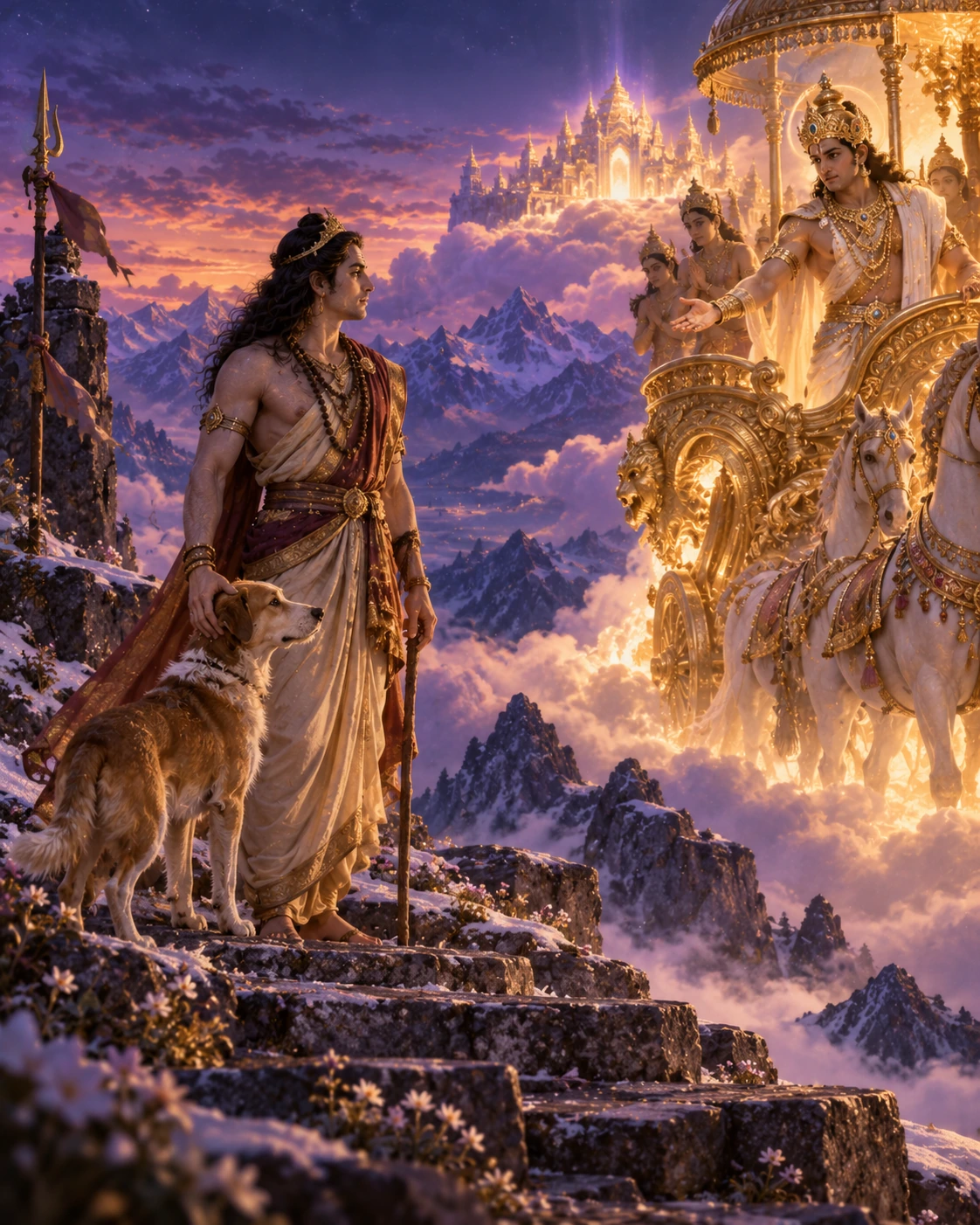
And then the sky opened and came down in a chariot.
Get in, he said. Heaven, now, in the body you are standing in — no dying first, no waiting. Nobody has ever been offered this. You have earned it.
Yudhiṣṭhira said: the dog comes with me.
And Indra said no. Not unkindly, and not as a test — as a fact. There is no place in for dogs. It is not done. He explained it more than once, the way you explain something to somebody who has misunderstood a small practical detail.
He pointed out, reasonably, that Yudhiṣṭhira had left his own brothers on that road without breaking step, and that a dog was a strange place to draw a line.
Yudhiṣṭhira's answer is one sentence long and it has outlived everybody in the book.
The dog came to me, he said. It has nobody else, and it is frightened, and it has done nothing wrong. I will not throw off somebody who took shelter with me to buy something for myself — not a kingdom, and not heaven either.
And he got down out of the chariot.
The dog was his father.
It had been the whole way — Dharma himself, walking beside him on that road, saying nothing, being ignored, getting hungry and tired, waiting to find out what this man would do when there was nothing left to be seen doing it for.
It was the last test. It was also the only one in the entire book that was not about a kingdom, or a war, or a promise made in front of witnesses.
And his father told him so, out loud, standing there on the mountain: that he had been watched, and weighed, and that nobody else had ever refused what he had just refused.
It was not the first time the two of them had done this. Years earlier there had been a lake, and a voice asking questions, and the same man giving the same kind of answer. His father had wanted to see whether it held when there was nothing left to gain.
slow down hereHe walked past his own brothers on that road and did not break step. He would not walk past a dog that had nobody else.
Short · 3 min aloud
At the end of everything the five brothers gave the kingdom away and started walking north, on foot, to die. went with them. So did a dog, which nobody had invited and nobody sent away.
They fell one at a time on that road. Draupadī first. Then the youngest, then the next, then , then .
did not stop and did not look back. When somebody still walking asked him why the one behind had fallen, he gave an answer, and kept going.
In the end there was a man and a dog, and a mountain, and nothing else.
Then came down with a chariot. Get in — you are the only person ever to be offered this in your own body, without dying first.
Yudhiṣṭhira said: the dog comes.
Indra said there was no place in for a dog. He was not being cruel. It was simply the rule, and he said so several times, patiently, the way you explain something obvious.
And Yudhiṣṭhira — who had lost a war's worth of people, and his wife, and all four brothers on that same road, and had not turned round for any of them — got out of the chariot.
He said the dog had come to him for shelter and he was not going to leave it standing on a mountain to buy himself something. Not heaven. Not anything.
The dog was his father. It had been the whole time, and it had been the last test, and it was the only one that had ever actually been about him.
His father told him so where he stood: that he had been watched the whole way, and that nobody else had ever turned that down.
slow down hereEverything he had was gone by then, and the one thing left was a hungry dog with nobody. He chose the dog over heaven, and that turned out to be the only question he was ever really asked.