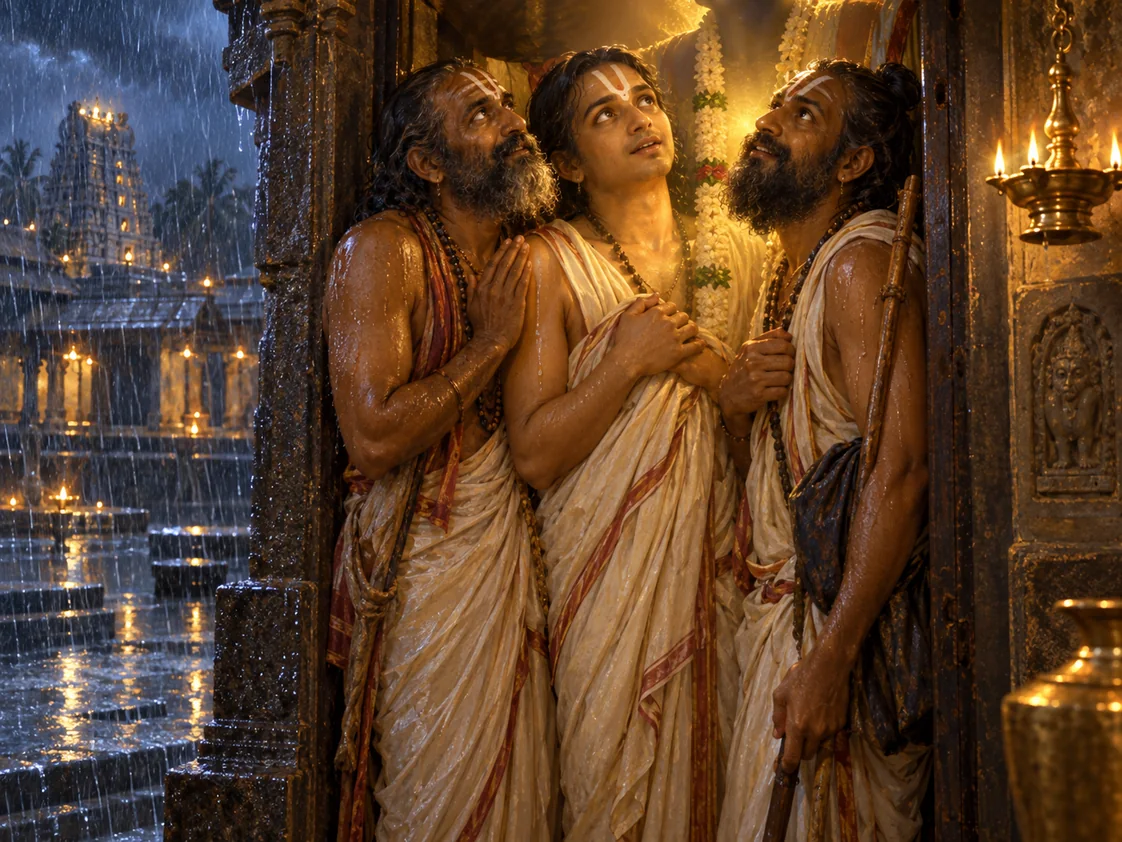
Three men were walking that night, in three directions, in rain that had set in.
They had never met. One had come from a pond near Kāñcīpuram, one from the shore at Mahābalipuram, one from Mylapore by the sea. What they had in common was that none of them could stop thinking about , and all three happened to be passing through a town called on the same wet night.
The first to give up on walking was .
He found a doorway. Not a room and not a porch — the narrow passage between a hut's outer door and the street, roofed, open at one end. There was room in it for a man to lie down, and he did.
Some time later somebody knocked.
There is only room here for one to lie down, said. He was not being unkind. He was describing the doorway.
And out of the rain the second man, , said: if there is room for one to lie down, then there is room for two to sit.
Which was true. thought about it in the dark, and sat up, and let him in, and the two of them sat.
Some time after that, somebody knocked again.
There are two of us sitting in here, they said, and that is the whole of it.
And out of the rain the third man, , said: where two can sit, three can stand.
Which was also true. So they stood, and let him in, and there were three men standing shoulder to shoulder in a doorway wide enough for one, in the dark, with the rain going past the open end.
That is already a good story, and it is not the story.
Notice what each of them actually did. Nobody argued. Nobody said the man outside should have set off earlier, or that there were other doorways.
Each one was told the honest size of the space and answered by finding a smaller way to be in it — from lying, to sitting, to standing. And each time, the person already inside got up and made the change himself.
Because then it got tighter.
Not a squeeze from outside. From the middle. There was somebody standing between them who had not come down the road and had not knocked, and they could all feel him, and not one of them could see a thing.
So the first of them made light.
Not with a lamp — this is the part the tradition is careful about, and it matters. There was no lamp in that doorway. What did was say a poem, and the poem was about making a lamp.
The earth for the lamp-dish, he said. The wide sea poured in for the oil. And the burning sun for the flame.
And the second one answered him with another one, and made a smaller and much closer lamp. Love for the dish, said . Longing poured in for the oil. And for the wick, a mind melting with joy.
And by the light of those two the third one looked, and saw, and began to say what he could see.
And the first thing out of 's mouth was not the god.
Three men who had never met, soaked through, in a doorway meant for one, and the third one opens his mouth and the first word is hers.
I have seen Tiru, he said — the goddess, , standing there. And then I saw the golden body. And the colour of the sun on it. And the wheel in one hand, and the conch in the other.
So: two of them had pressed in, not one. He had brought her with him.
And the lord of has a second name in that town, which he had before any of this and has kept since. They call him the lord of the threshold.
slow down hereNobody in that doorway had ever had room. That was never what the night was about.