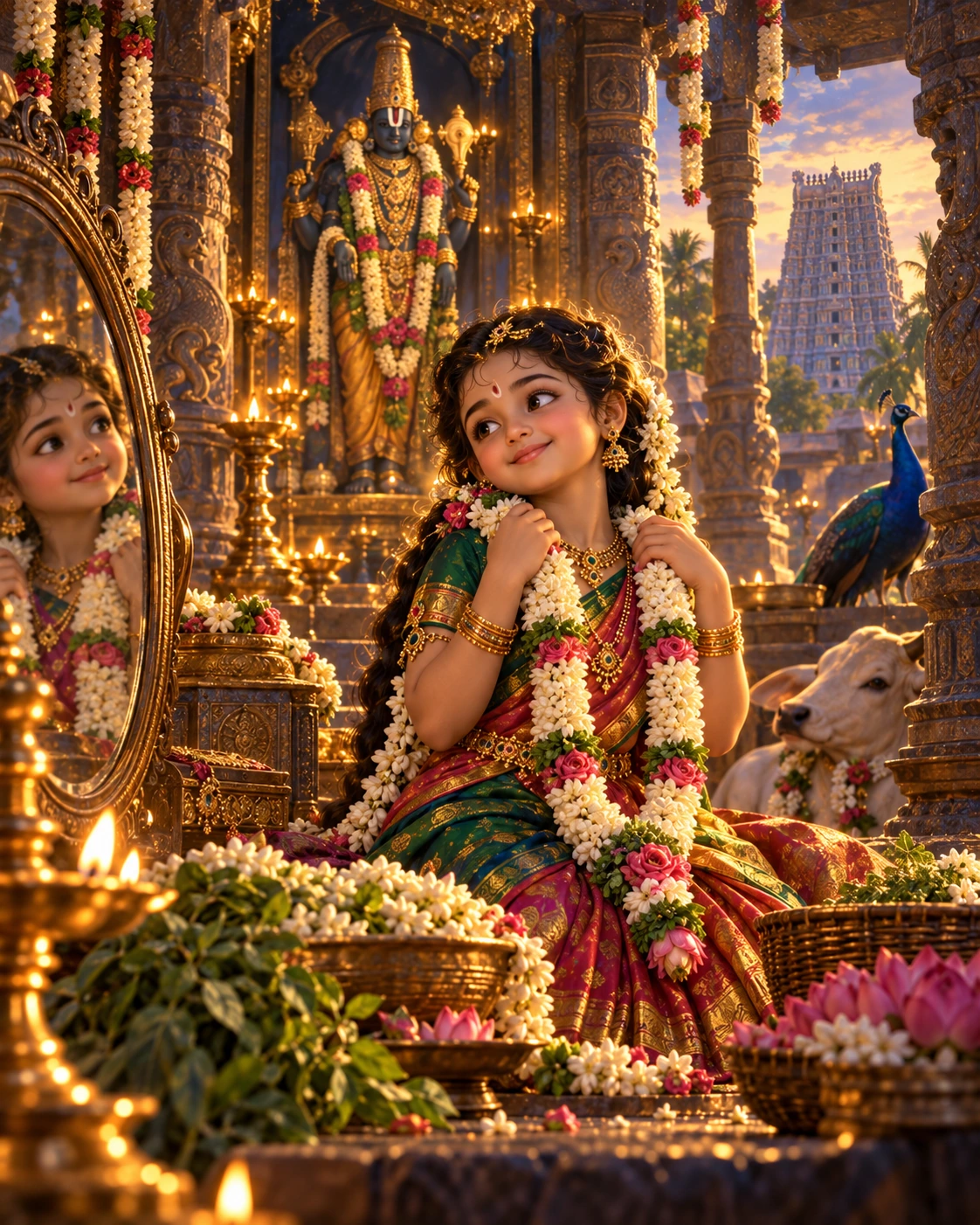
In there was a man who had given up everything else to grow flowers. Not to sell. He grew them for the god of that town, who lies on a banyan leaf and is called Vaṭapatraśāyī, and every single morning he tied a garland and carried it into the temple himself.
He had a daughter. He had found her as a baby under a tulasi plant in the flower garden and brought her home, and he had named her , and she had grown up inside the smell of jasmine being knotted onto thread.
The garland was always made the evening before and left ready in the house overnight.
And every night, before it went anywhere, put it on.
She lifted it over her head with both hands, the way you would lift something you were being given, and let it hang down the front of her. Then she went out to the well in the yard and leaned over and looked at herself in the water.
She was not playing dress-up. She was checking. She had decided, somewhere quite early and entirely on her own, that she was going to marry — not somebody like him, not somebody he sent, him — and she wanted to see whether she looked like a person that was going to happen to.
Then she took it off, and put it back exactly as it had been lying, so that the loops fell the same way, and she went to bed and said nothing about it.
This went on for a long time. Nobody knew.
What she was doing was not vanity, and it is worth being exact about it. A garland is what you put on somebody at a wedding. She was putting on the one thing in the house that was going to touch him, and then going to look at the two of them together in the water.
And every morning her father carried that garland into the temple in both hands, with the care of a man handling the one thing in his life he is completely sure of.
Then one morning he found out.
The tellings differ about how — a single long hair caught in the flowers, or he came round the corner of the house early and simply saw her at the well with it on.
He was not angry in a shouting way. What he felt was much worse than anger. In everything he understood about the world, a garland for a god must be untouched, and he had been carrying up a worn one, morning after morning, for months, without knowing.
So he did the only thing he could think of. He took that garland away and threw it out. He tied a fresh one, and nobody wore it, and he carried it in, and the worship that day was correct in every particular.
And that night he dreamed.
came and stood in his dream and asked him one question, and the question was not about rules.
Where is the other one?
This is the part to go slowly over, because it is easy to hear it as the god being kind about a child's mistake, and that is not what the story says.
He wanted the worn one. He said so. The garland his daughter had put over her own head and looked at herself in — that was the one he had been waiting for every morning, and had been getting, and had liked. The fresh one was flowers on a string.
And in they never went back to the correct way. To this day the garland is worn by her first, and then it goes to the god, and that is not an indulgence but the order of service.
slow down hereSo nobody calls her now either. They call her the one who wore it first and gave it after.