Somebody has to make the drums.
Every temple has them, and the skin on the head of a drum wears out and has to be replaced, and before it is a drum it is an animal that has died and a man who knows how to cut a hide and stretch it and dry it flat.
In the Chola country there was a man who did that work, in a village called Ādaṉūr by the river, and his name was .
He did more than the drums. He twisted gut into strings for the yāḻ, which is the old Tamil harp. When a temple needed the yellow pigment they use for marking the stone, he brought that as well.
So on any morning, in any of those temples, most of the sound and some of the colour had come out of his hands.
And he had never been inside any of them.
There was a rule. In that time and in that place, people born into his family did not go into the temple. They did not stand at the door either. They stood outside, at a distance that was understood by everybody and did not have to be said.
It was not invented that morning to be cruel to him. It was old, and it was simply how things were done.
That is the part that is hardest to explain and most important to say. He was kept out because of the family he was born into, and it was wrong, and almost nobody around him thought so.
He wanted, more than he wanted anything, to go to Chidambaram and see the Lord who dances. He would tell himself he would go — tomorrow, he would say, I will go tomorrow — and then not go, and say it again the next day.
He said it so often that it became his name. In Tamil they call him Tirunāḷaippōvār: the holy man who will go tomorrow.
On the way, he came to a place called .
And he did what he always did. He came up as far as he was permitted to come, and stopped, and stood in the road, and looked in through the gate towards the shrine.
And he could not see a thing.
Here is why, and you can check it yourself, because the building is still standing.
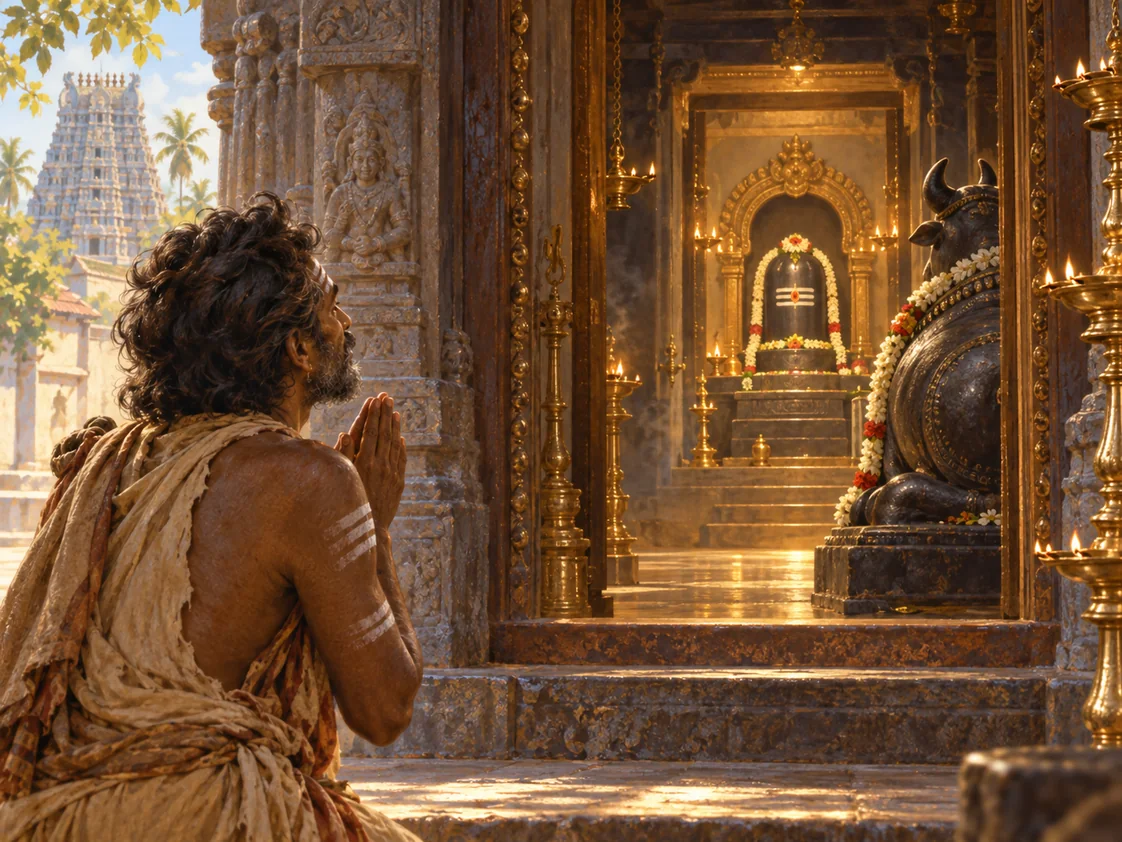
In a temple there is always a bull outside the shrine, lying down, facing in, looking at his lord. He has been looking for a very long time and he is not going to stop. At the bull is unusually large, and he was sitting exactly in the middle of the line between the gate and the god.
If you were allowed inside you would simply walk round him. If you were not allowed inside, and the gate was as close as you were ever going to get, then what you had come all that way to see was the back of a stone bull.
So stood in the road and looked at the back of the bull.
And the story says that looked out at the man standing in the road, and did not call him in, and did not argue with anybody about the rule.
He spoke to his own bull, in his own house, and told him to move.
And the bull stood up and stepped to the side.
Nothing else changed that day. The gate was not opened. No one came out to him. Nobody announced that the rule had been a mistake, and it went on being the rule for a very long time after he was dead.
One man in the road got to see, because the furniture was moved for him.
slow down hereThe bull at is still sitting off to one side, out of the way of the door. You can go and stand where he stood and look.