There was a singer called , and every day he stood by the Kāvēri facing Śrīraṅgam.
Across the water was , reclining in the dark of the temple. Tiruppāṇāḻvār sang to him from outside.
The later Śrīvaiṣṇava life-story says he kept himself from entering because he believed his birth made him unqualified to step inside. That detail belongs to the hagiography. His own ten surviving verses do not tell us this story, and modern historians warn that the social history of the Pāṇar was more complicated than the later biographies make it sound.
That distinction matters. We can tell what the tradition says without turning every part of the tradition into a simple historical fact.
That does not make the devotion less real inside the tradition. It tells us something else: a life-story can carry a community's memory, while the poem carries the poet's own voice.
Both matter, but they answer different questions. So as the story continues, we will keep saying which details come from the later biography and which come from the ten verses themselves.
One morning the temple priest came down to the river to collect water for the Lord's service.
Tiruppāṇāḻvār was standing in the path, eyes closed, completely inside his song.
The priest called to him to move. The singer did not answer. He had not decided to ignore the priest; he simply did not hear him.
The priest called again. Then, trying to clear the path, he picked up a stone and threw it.
The stone struck Tiruppāṇāḻvār on the forehead and drew blood.
The singer came out of his absorption, saw what had happened, and apologised for being in the way. Then he moved aside.
The priest took the water to the temple and continued his service.
That night, the hagiography says, Raṅganātha came to him in a dream.
The message was not: you threw a stone at a stranger. It was: the offence was against me. And the Lord told the priest to go back and bring his devotee in.
So the priest returned to the river.
Tiruppāṇāḻvār refused to enter. The same belief that had kept him outside before the stone was still there: he did not think someone of his birth should cross into the temple.
This is where an important part of the old telling is often blurred.
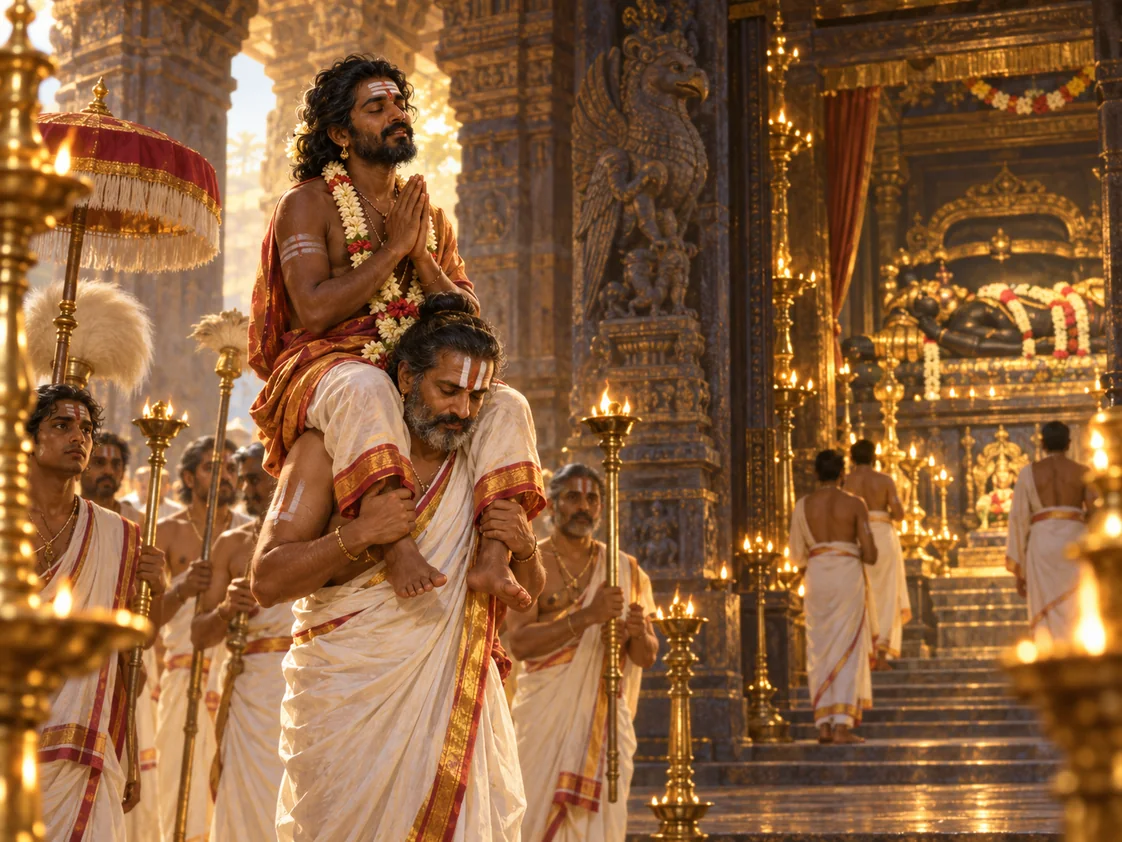
The Lord had commanded the priest to bring him. The Lord had not said, put him on your shoulders. The shoulders were the priest's answer to the Āḻvār's refusal.
The archaka offered his own back. If Tiruppāṇāḻvār would not walk in, the priest who had tried to move him out of the way would carry him in himself.
That carrying is not presented by the tradition as a trick for preserving an old exclusion rule. It is an honour so central to the memory of the episode that Tiruppāṇāḻvār is remembered as Munivāhana — the one for whom the sage became the vehicle — and Vedānta Deśika later gave his commentary the title Munivāhana Bhōgam.
The person who had treated the singer as an obstacle became the person who bore him.
When Tiruppāṇāḻvār finally saw Raṅganātha, the tradition places his ten verses there, at the darśana.
The poem is the Amalanādipirāṉ. It begins at the Lord's feet and moves upward through his form. The river, the stone and the priest are not in those ten verses; those belong to the later life-story around the poem.
And the popular line that he sang nine verses on the road and only the tenth before Raṅganātha is not supported by the checked telling. The ten belong to the seeing.
In the final verse, his eyes have seen the one they wanted to see, and they will not look elsewhere.
slow down hereIn the morning, the priest had thrown a stone because a singer was in his way. By the end of the story, that same priest had become the singer's vehicle into the presence he had spent his life singing toward.