Full · 6 min aloud
The search for had brought the vānaras to the edge of the sea.
The water before them stretched a hundred yojanas.
They had learned that Sītā was across it. Now someone had to cross.
One by one, the vānaras said how far they could leap.
Ten yojanas. Twenty. Thirty. Forty.
Others offered fifty, sixty, seventy, eighty.
Old said that in his youth his strength had been far greater, but now he could manage ninety.
said he could cross the hundred yojanas.
But he was not certain he could cross back.
Jāmbavān would not send him.
A leader, he said, was not the one to be sent when others could do the work.
Aṅgada looked at the great company around him.
If he did not go, and no other vānara could go, what were they to do?
Jāmbavān answered him.
This work will not fail. I will call upon the one who can accomplish it.
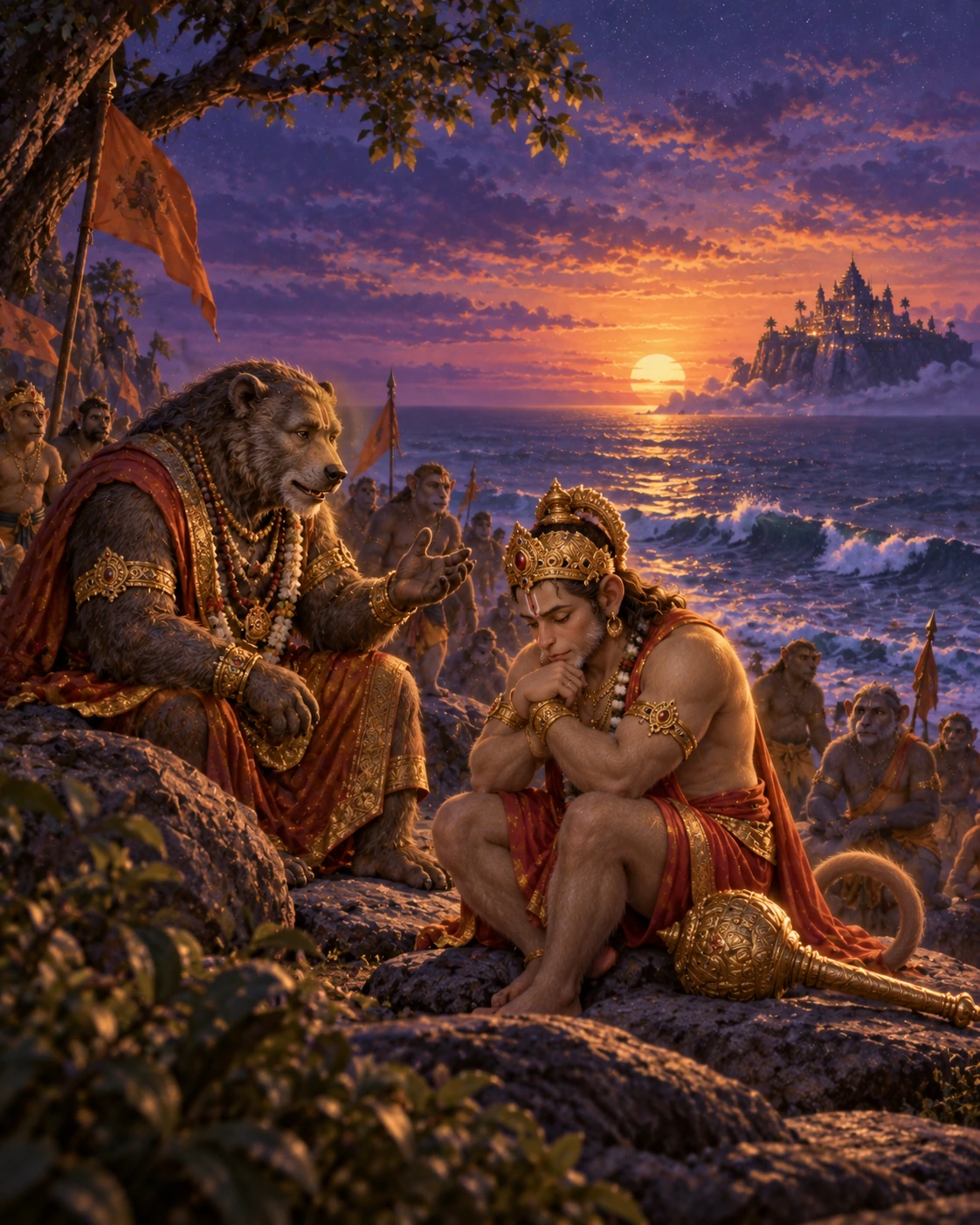
A little apart from the others sat .
He had not joined the measuring.
Jāmbavān turned to him.
Hanumān, why are you sitting here silently?
Then Jāmbavān began telling Hanumān about Hanumān.
He spoke of his strength and his speed.
He told him that in brilliance and power he stood with , with and with .
He compared the strength of Hanumān's arms to the strength of 's wings.
Your strength, intelligence, brilliance and courage are extraordinary, Jāmbavān told him.
Why do you not know yourself?
Then the old one went further back.
He told the story of Hanumān's birth as a son of , the Wind.
He reminded him of what he had done as a child.
Hanumān had seen the rising sun and taken it for a fruit.
He had leapt into the sky after it.
Jāmbavān said the child had travelled three hundred yojanas towards the sun.
had struck him with the thunderbolt.
Hanumān had fallen onto a mountain, and his left jaw had been broken.
That broken jaw, Jāmbavān said, was why he was called Hanumān.
When Vāyu saw what had happened to his son, the Wind stopped moving.
The worlds were troubled.
The gods came and gave the child boons.
granted that weapons would not kill him.
Indra granted that even death would come only when Hanumān chose it.
Jāmbavān had reached the point of his story.
I am old now, he said.
My former strength has gone.
But this is your time.
He told Hanumān to rise.
He told him to cross the ocean.
All the vānaras were discouraged, Jāmbavān said.
Why do you remain still?
Move.
And Hanumān did.
The Rāmāyaṇa says that, urged on by Jāmbavān, the son of the Wind made his body immense.
The vānaras praised him.
Hanumān grew larger, and his strength rose with their praise.
He stood among them with his hair bristling in joy.
Then he bowed to the elders and spoke.
Now Hanumān began saying what he could do.
He said no one could equal him in leaping.
He could circle again and again.
He could disturb the ocean and shake mountains as he flew.
He could follow the sun across the sky before it set.
He could cross thousands of yojanas.
Then he came to the task in front of them.
I will see Sītā.
Rejoice.
Jāmbavān answered him with delight.
You have taken away the great grief of your people.
He told Hanumān that all their lives now depended on him.
Hanumān looked for ground strong enough to bear the force of his leap.
He chose Mount .
He climbed it.
The mountain was covered with trees and animals.
Hanumān walked across its great peaks, preparing to launch himself over the sea.
As he pressed down with his feet, the great mountain shook. Water streamed from it, rocks broke loose, animals fled, and birds rose into the air.
This was the ground Hanumān had chosen for the leap.
slow down hereUrged on by Jāmbavān, Hanumān rose, enlarged his form, and prepared to cross the sea.
Short · 3 min aloud
The vānaras had reached the sea while searching for .
Across that water lay their task.
One by one they said how far they could jump.
Ten yojanas. Twenty. Thirty.
Others could manage more.
Old said he could go ninety now.
said he could cross the hundred-yojana sea, but he was not sure he could return.
Jāmbavān would not send him.
This work will not fail, he said. I will call upon the one who can accomplish it.
A little apart sat .
He had said nothing.
Jāmbavān turned to him.
Why are you sitting here silently?
Then he began telling Hanumān about Hanumān.
He spoke of his strength, intelligence and speed.
He told him that his arms were as powerful as 's wings.
He reminded him that he was the son of .
As a child, Hanumān had seen the rising sun and leapt towards it as though it were a fruit.
struck him with the thunderbolt and broke his jaw.
When Vāyu stopped the wind in anger, the gods came and gave Hanumān extraordinary boons.
Jāmbavān finished.
I am old now. This is your time.
Rise. Cross the ocean.
The Rāmāyaṇa says that, urged by Jāmbavān, Hanumān made his body enormous.
The other vānaras praised him.
Hanumān stood up among them and began saying what he could do.
He could shake mountains.
He could disturb the sea.
He could travel immense distances through the sky.
Then he said the thing the others needed to hear.
I will see Sītā.
Jāmbavān told him that he had taken away their grief.
Hanumān climbed Mount , choosing it as the place from which he would leap.
As he pressed his feet against the mountain, it shook beneath him.
slow down hereThe one who had been sitting silently stood up and said, I will see Sītā.