Full · 6 min aloud
was sixteen years old.
That is worth holding on to for the whole of this, because the story is very good at making you forget it.
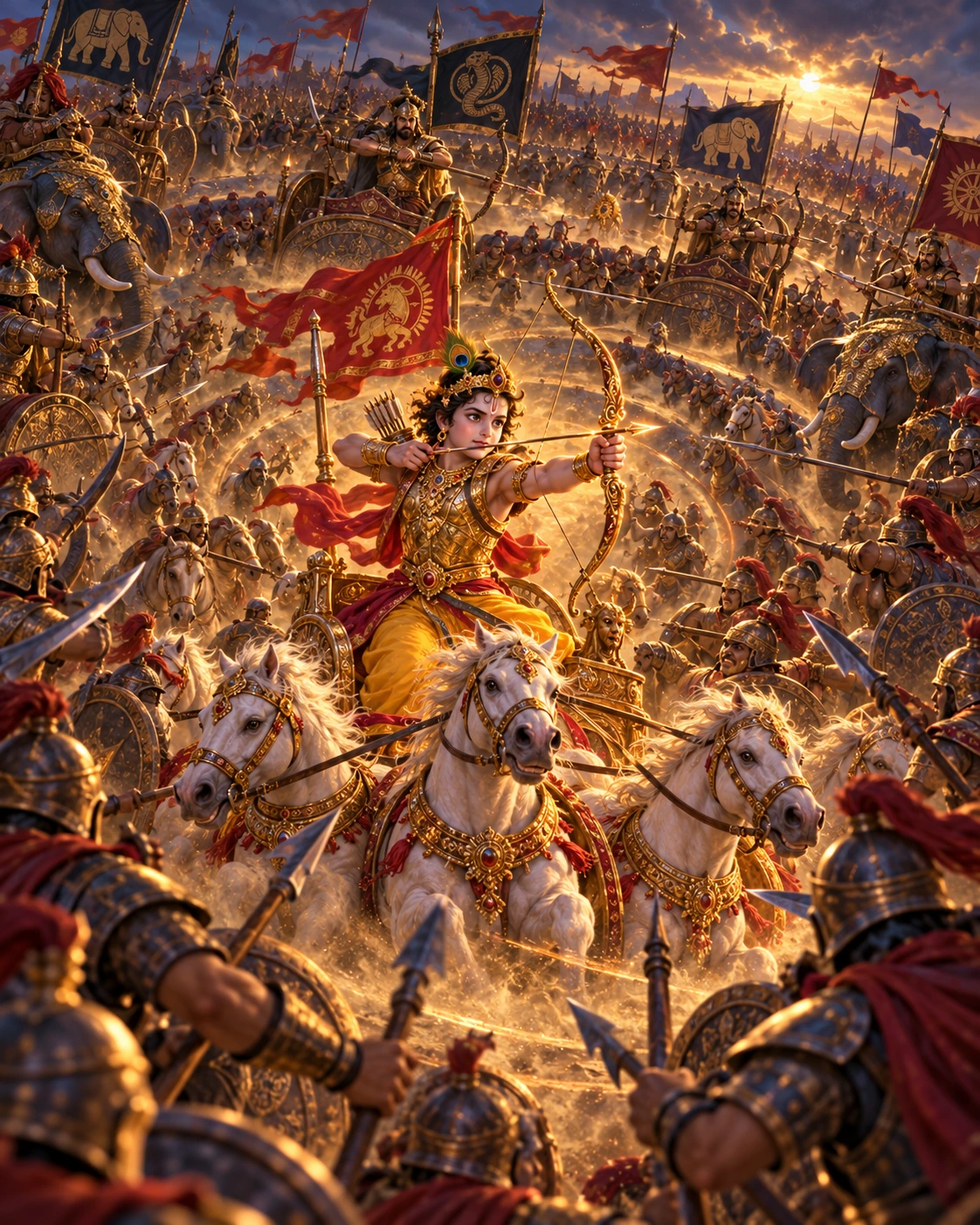
On the thirteenth day drew the army up into a .
It is a formation shaped like a coiled wheel — ring inside ring, turning, closing behind whatever comes in. Getting in is one skill. Getting out is a different one, and only a handful of men alive had both.
was one of them. Which is precisely why, that morning, a part of the enemy army had gone off and challenged Arjuna somewhere else entirely, and Arjuna had gone.
So the formation was there, and the man who could open it was a long way off, and the day was going badly.
They asked his son.
And this is the sentence the whole story turns on, because Abhimanyu did not pretend. He told them, before he went, to their faces: I know how to get in. I do not know the way out.
You may know the famous explanation that he learned only half the formation before he was born. That explanation is a later retelling, not part of this Sanskrit passage.
They say he heard it before he was born — explaining the formation to while she was carrying him, and Subhadrā falling asleep partway through, so the child got the going in and never got the coming out.
Half a lesson, because somebody was tired.
They sent him in anyway.
Not carelessly — there was a plan, and it was a reasonable one. He would break the gap open and the rest of them would come straight through behind him, and once they were inside it would not matter that he could not get out alone, because he would not be alone.
agreed to it. Everybody agreed to it. It is important that this was not a trick played on him by his own side.
He went in, and the gap opened, and it worked.
And then one man stood in that gap and held it.
had a boon — for one day, he could hold off four of the five brothers. This was the day. He stood in the mouth of the formation and the rest of the army came at him and could not get past him, and the rings turned, and closed.
Somewhere on the other side of that, a boy who had been told he would not be alone found out that he was.
What he did inside takes the epic many chapters, and it does not hurry any of it.
He went through the army. Commanders, chariots, elephants, whole sections of it. Men who had fought for thirty years could not stand in front of him. The epic names them one after another so there is no mistaking this for luck.
He was, by an enormous margin, the best thing on that field, and he was sixteen, and he could not leave.
So they stopped fighting him one at a time.
Six of them came at once — the teacher who had taught half of them, and , and four more. His bowstring was cut from behind, on Droṇa's word. Then the bow. Then the chariot, then the horses, then the man driving it.
He got down and pulled a wheel off the wreck and fought on with that, on foot, holding a wheel, which is how every painting of him shows him and is not an exaggeration.
And then 's son came up behind him with a mace, and that was the end of it.
There is no easy consolation here. Nobody is rewarded. comes back that evening and has to be told.
slow down hereEvery adult on that field knew he only half knew it, because he had said so out loud before he went. They sent him in on a promise to be right behind him, and then one man shut the door, and not one of them could reach him.
Short · 3 min aloud
was sixteen.
On the thirteenth day of the war drew the army up as a — a formation coiled like a wheel, ring inside ring, that closes behind whatever comes in. Very few men alive knew how to open it. was one of them and Arjuna had been drawn away to the other end of the field on purpose.
So they asked his son.
And here is what he told them, before he went, plainly and to their faces: I know how to get in. I do not know how to get out.
You may have heard that he learned it before he was born — his father explaining it to his mother, and his mother falling asleep partway through, so he heard the way in but not the way out.
They sent him anyway. He would open the gap and they would come through it behind him. That was the arrangement and everybody agreed to it.
He went in. And behind him, one man — — stood in the gap and held it shut, and the rest of them could not get past.
He was alone in there for a long time, and he was extraordinary. The epic follows that fight for chapter after chapter and does not hurry.
Then six of them came at him at once. His bowstring was cut from behind. His chariot went, his horses went, his driver went, and he pulled a wheel off the wreck and fought on with that.
And then somebody hit him from behind with a mace, and that was the end of it.
slow down hereEvery adult in that field knew he only half knew it. He told them so himself. They sent him in, and then the door shut, and none of them could reach him.