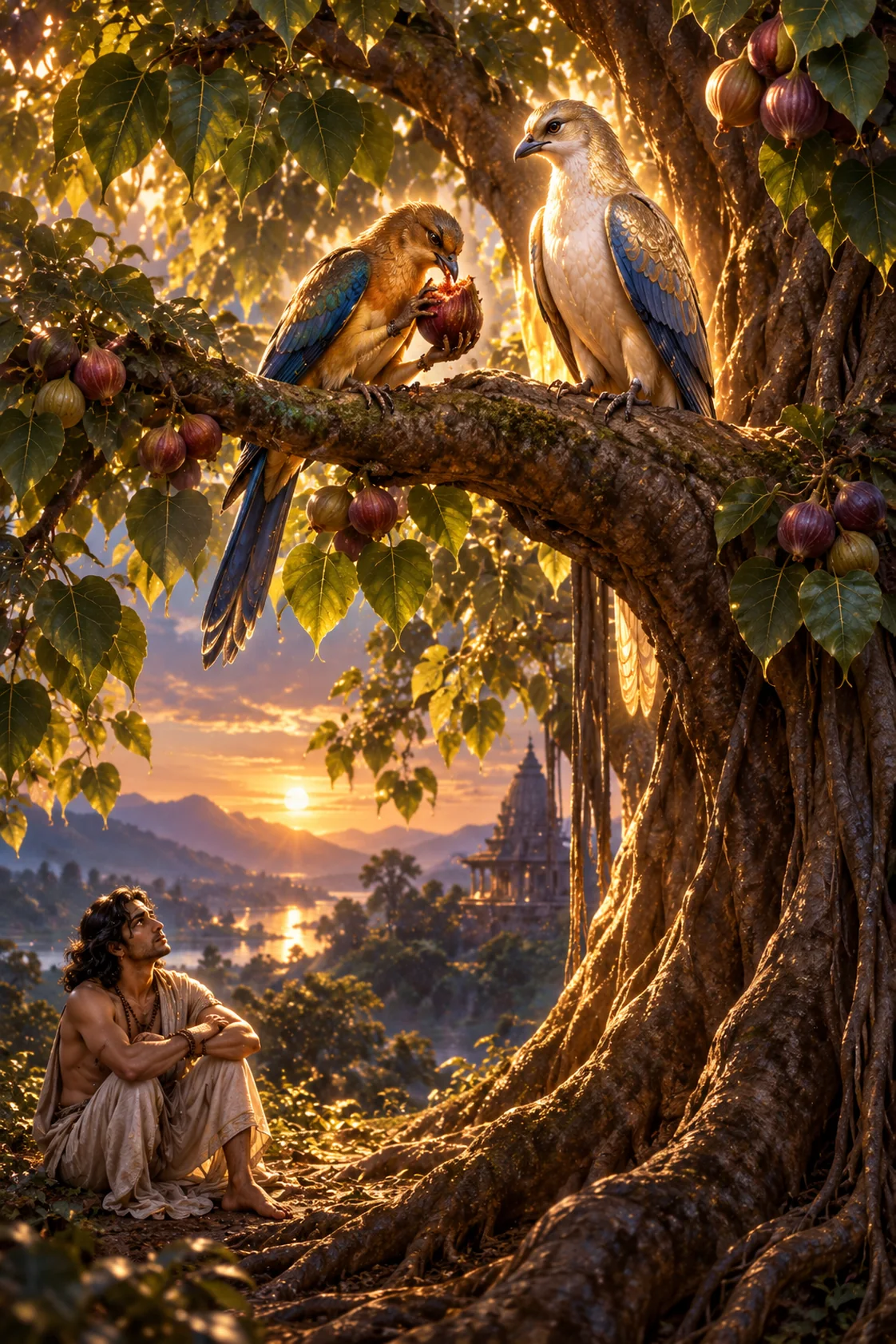
There are no people in this one. There is no king, nobody is banished, nothing is won. There is one line, and it is one of the oldest lines anybody says out loud.
Two birds, it says. Both of them beautiful. Yoked together — that is the word the verse uses — and friends, and they have hold of the same tree. Not perched on it: the verb is closer to clasping it.
One of the two is eating the fruit. The verse says the fruit is sweet, and it gives the fruit a name, , which is the fig.
The other bird is not eating anything at all. He is looking. The word is stronger than looking — it is the kind of watching you cannot break off.
That is the whole picture. One tree, two birds, one of them busy and one of them still. You could draw it on the back of an envelope.
The next verse does something odd, and it is the one that stops people. It stops saying bird. It says a man.
On that same tree, it says, a man is sunk down and grieving. And the reason it gives for the grief is not hunger and not loneliness — it is that he feels he is not the master of anything. Things are happening to him.
And then the turn, and it takes half a line.
When he sees the other one. When he sees the other one, and sees how great he is — then the grief is gone. Not lessened. Gone.
The verse has a name for the second bird at that point. It calls him the lord. It does not say anything more about him.
Now go back and look at what the second bird actually does in all of this.
Nothing. He does not come down. He does not call out or explain. He does not take the fruit away, and he never once stops the other one eating it.
In those two verses he has two things he does: he does not eat, and he keeps looking. He is not even the one who moves at the end. The entire change is in the one who looked.
So who are they? Here is the honest answer, which is more interesting than a tidy one.
The old teachers do not agree. One great commentator reads the eating bird as you, caught up in a body, and the watching one as the same self, never caught at all. Another insists that the two never become one and were never meant to. The verse itself names neither.
It also never says what the tree is. The tree is only ever the tree. That it stands for the body is a teacher's explanation, and it is not in the line.
And there is one more thing, which children like better than adults do.
The first of the two lines is older than the book it is famous from. It is already sitting in the , word for word, inside a long hymn of riddles by a seer called . Three books carry that one.
And people reading it back there, in the oldest of the three, have taken the two birds for something else entirely — the sun and the moon. That is a different argument from the teachers' one, and it is not closed either.
In the the picture also goes a little further than it does here. There are many birds in that tree, not two. And the sweetest fig of all is at the very top, and the hymn says only one kind of person ever gets up there to it.
slow down hereWhatever else is unsettled, the line itself is not: two of them on the same branch, one eating and grieving, one watching and still — and everything that happens in it happens because one of them looked.