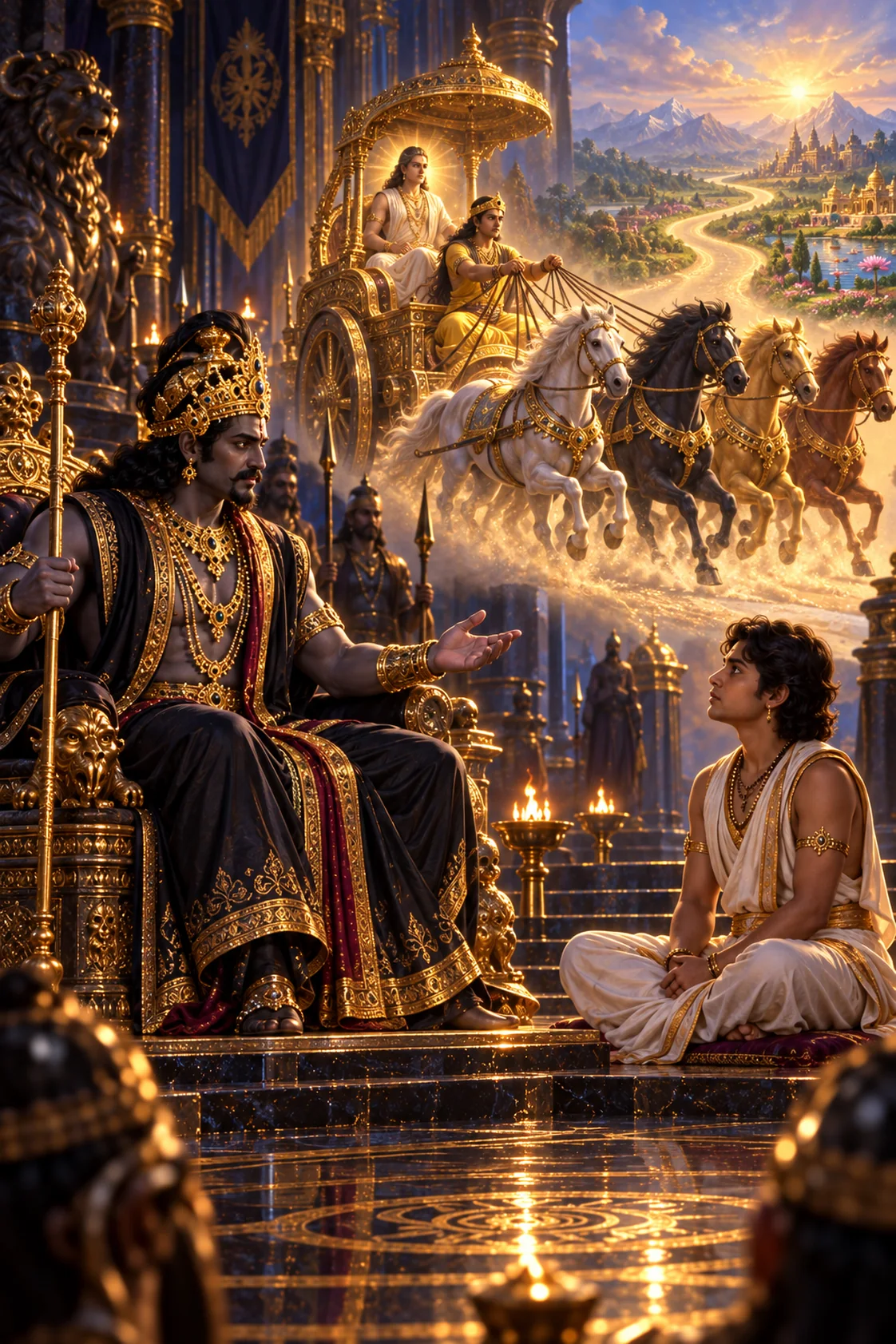
was standing in 's house, and he had been offered a great deal to go away. Sons and grandsons. Cattle and elephants and gold. Horses. Wide lands, and as many years as he liked.
He had one question and would not trade it for any of that: what becomes of a person after they have died. He had come to the one who could not pretend not to know.
Before the picture, told him one other thing. There is what is good for a person and there is what is pleasant to them, and they are two different things. Both of them come. A steady person looks at both and takes the good one.
Then he answered the question. And he did not begin by explaining. He drew a picture.
Think of yourself, he said, as a chariot.
Not riding in one. Being one. The body you are walking around in is the chariot — the frame of it, the wheels, the boards under your feet.
The horses pulling it are your senses. Everything in you that reaches out and wants to get hold of something. Those are the horses, and horses are strong, and horses run.
And the roads they run down are everything there is out there to be reached for. That is what a road is here. Somewhere a horse can take you.
Then he said the part everybody forgets.
There is a driver up on the chariot, and there is somebody being carried in it. is careful about this. They are not the same one.
The driver is your understanding — the part of you that puts one thing beside another and decides between them. The reins in the driver's hands are your mind. And the one being carried, the one the chariot belongs to, is you.
All of it moving together — the rider, the mind, the horses — is what the wise call the one who tastes.
If the driver has no sense, said , and the reins lie slack in his hands, the horses stop listening to him. They go where they like. He is a man with bad horses, and everybody has met one.
If the driver has sense, and holds the reins, the horses do what he asks. The same horses. The same road.
Notice what he has not said. He has not said the horses are the trouble. A chariot with nothing harnessed in front of it does not go anywhere at all.
And he has not told you to take the reins yourself. You are not the driver in this picture. You are the one being carried, and the question he is handing you is who you have got up there.
The one whose driver has no sense does not arrive, he said. He comes round again, and is born again, and finds himself back on the same road.
The one whose driver has sense arrives. He reaches that place, and he is not born again.
There is a third word sets down beside the sense and the reins, in both of those verses, and it is harder to carry across. Clean. Not washed — something more like unmuddied. The verse does not explain it.
And to the one who gets there he gives a name for the end of the road — the highest step of — and no explanation at all, and then goes on to something else.
A few verses further on, the puts the chariot down and speaks straight out, to anybody who happens to be listening.
Get up, it says. Wake up. Now understand.
And then, so nobody mistakes it for an easy morning: the path is as hard to walk as the sharpened edge of a razor. So the wise say.
slow down hereHe had asked what becomes of a person after they die, and answered by describing what it is like to be one — a chariot, moving fast, with strong horses in front of it and somebody up there holding the reins.