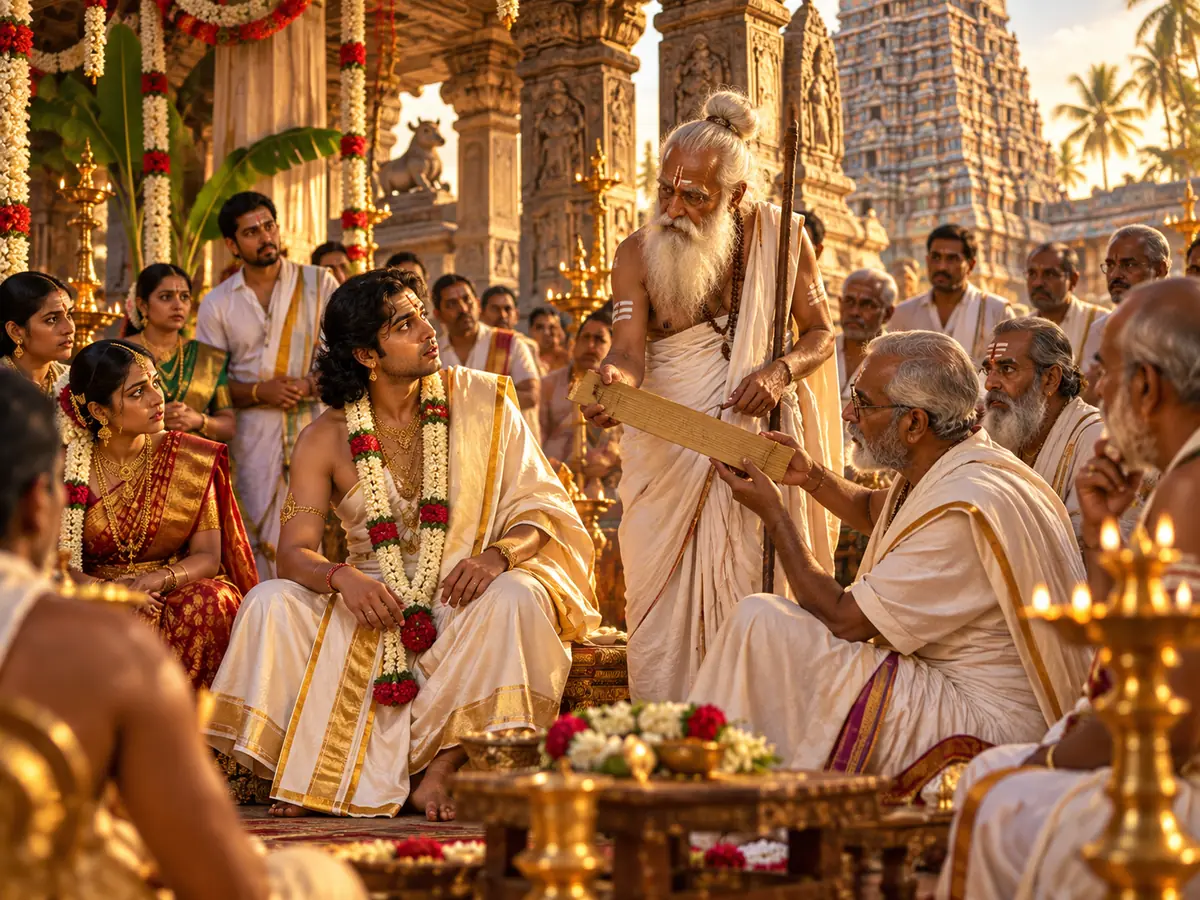
The wedding hall was ready. , young, learned and dressed as a bridegroom, had come with relatives and guests to marry the daughter chosen for him. The Periya Purāṇam lets the celebration gather around him before one old brahmin walks in and asks the whole hall to listen.
The stranger says there is a matter to settle before any marriage can go forward. , he claims, is bound to serve him because the young man's grandfather wrote a deed promising that service for his descendants.
The hall is astonished. is more than astonished. He challenges the claim and asks to see the palm leaf. The old man shows a copy. In anger, takes it and tears it.
The old man does not abandon the case. The torn leaf, he says, was only the copy. The original can be produced before the learned assembly at Tiruveṇṇainallūr. If thinks the claim is false, let the court decide.
They go. The poem does not treat the assembly as decoration. The elders hear both sides and question the claim itself. One brahmin claiming another as a hereditary servant is not something they simply accept. They ask for proof.
The old man produces the original palm-leaf deed. Proof of age is not enough; the assembly needs to know whether the signature really belongs to 's grandfather. They bring another document whose writing is known and compare the hands.
The writing matches. On the evidence placed before them, the elders rule for the old man.
It is an uncomfortable scene to read with modern ears because the document speaks in the language of inherited servitude. The hagiography uses that legal form to describe belonging to ; it is not an argument for one human being owning another. Inside the story, however, has genuinely lost the case.
He had been sure the old man's claim was impossible. The assembly he agreed to trust has decided otherwise. So he does what the ruling requires: he goes with the claimant.
The elders have one more question. The old man has said he belongs to that place; where is his house? He leads them toward the temple at Tiruveṇṇainallūr. follows. Once inside, the old man is no longer there.
Then reveals who had stood in the wedding hall and argued before the court. He tells that the interruption was not random: he has come to claim the service that links them.
The wedding has stopped, the lawsuit has ended, and now another task begins. asks to sing Tamil in his praise.
The request is not for Sanskrit learning or a court defence now. It is for song in the language speaks, and the man who argued so fiercely has to discover what to say first.
There is a problem. does not know how to begin. During the quarrel he had called the old man pittan—a madman. tells him to use that very word as the opening.
So the sharp word spoken in anger is not erased from the story. It is turned. begins his first hymn with Pittā, pirai-sūḍī…—addressing the Lord who wears the crescent moon.
That hymn belongs to the Tēvāram and can be read apart from the biography. The lawsuit that leads into it is the Periya Purāṇam's hagiographic telling.
Keeping those two layers apart matters: the poem sung by is an early textual witness to his voice; the courtroom scene is how the later Tamil Śaiva tradition tells the beginning of his service.
The court did not prove that human slavery was right. Within the saint's story it proved something narrower and stranger: the groom who thought his life was already arranged was being claimed for a different kind of service.
slow down here lost the argument he was sure he would win. The tradition remembers that loss as the doorway through which his first song entered the world.