Everyone remembers the enormous part of Vāmana's story.
Three paces become large enough to cover worlds.
But a medieval Sanskrit telling pauses just before that expansion and gives us a scene no wider than the mouth of a water-pot.
Bali was performing a great horse sacrifice under the guidance of Bhārgava priests when Vāmana arrived in the form of a dwarf brahmacārin.
The Uṣāharaṇa-kāvya tradition we are using says Bali welcomed him with devotion and was delighted by his presence.
Vāmana asked for only three paces of land.
Bali agreed to give them.
His teacher Śukrācārya opposed the gift.
That warning is also familiar from the Bhāgavata Purāṇa.
There Śukrācārya recognizes that the dwarf is Viṣṇu and tells Bali that three apparently small paces will cost him his sovereignty, splendour and position.
Bali hears the warning and still refuses to withdraw his word.
The donation now has to be completed ritually.
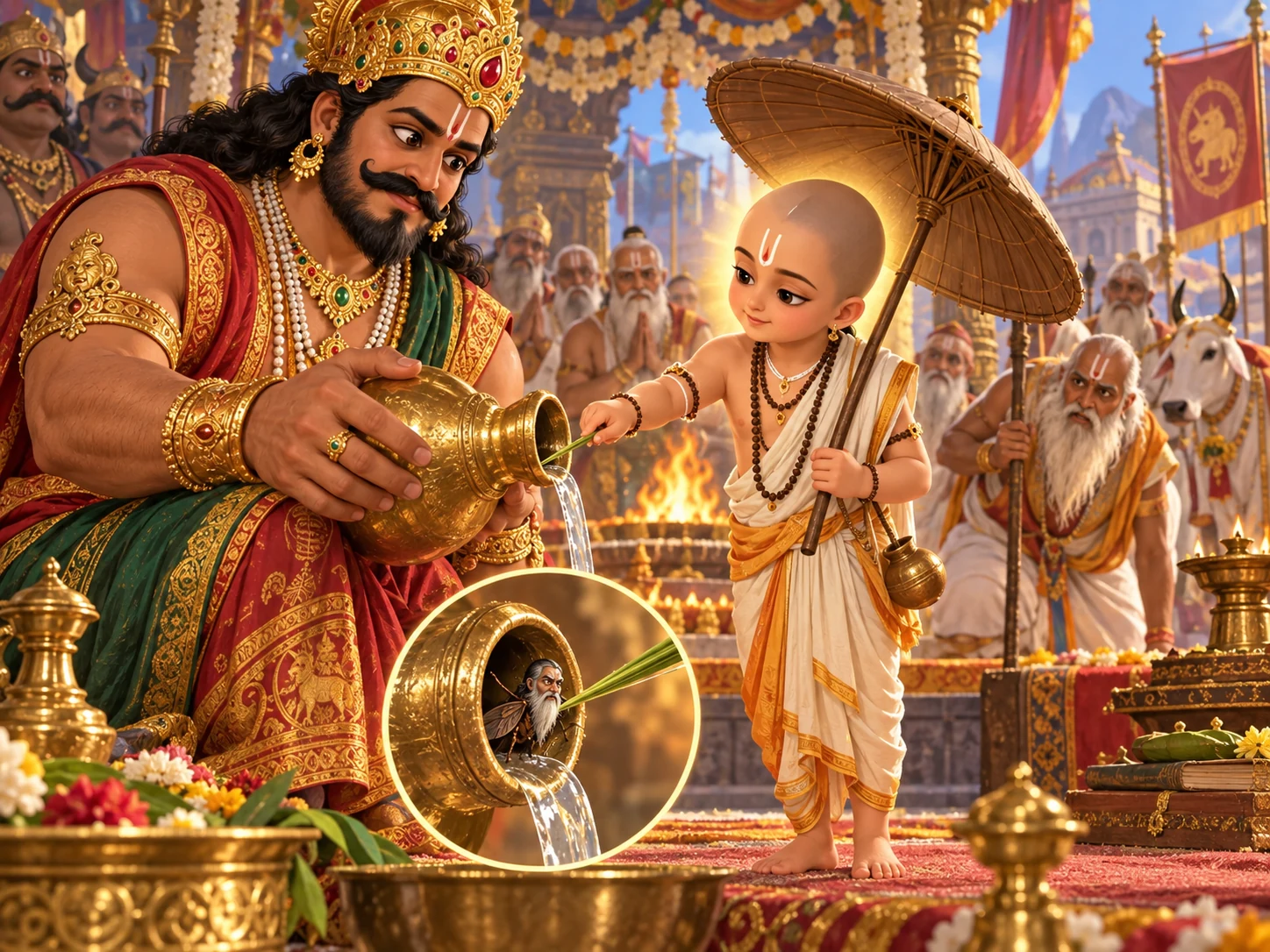
Bali takes up the vessel of water.
Here the rarer inside story begins.
The medieval source summary says Śukrācārya tried one more way to prevent the gift.
He made himself tiny — the English study uses the word mote — and entered the mouth of the water-pot.
The passage was blocked.
Water would not come out.
The entire donation was now stopped by something almost too small to see.
Bali could still intend to give.
Vāmana could still stand ready to receive.
The promise could still be repeated.
But the water that made the gift formal would not reach Vāmana's hand.
Vāmana understood the obstruction.
He picked up a blade of darbha grass.
He pushed the grass into the mouth of the pot to clear it.
The point struck Śukrācārya in one eye.
Śukrācārya moved away.
The water flowed.
The gift was completed.
Then the scale of the story changes completely.
Vāmana begins to measure the promised land and his form expands.
The tiny obstruction at the spout gives way to the cosmic stride that everyone remembers.
The first stride covers the earth. The higher region is covered. Bali must answer the question of the third step.
That larger episode already has its own telling.
This story is the hinge immediately before it.
It shows the exact moment a promise moves from intention into completed gift.
The sources do not all preserve this smaller scene in the same place.
The Bhāgavata Purāṇa gives Śukrācārya's warning, Bali's refusal, his curse on Bali and the ritual with the water vessel, but it does not narrate the tiny-form spout blockage or eye injury.
The later Uṣāharaṇa-kāvya tradition does narrate the mote in the pot and the darbha striking Śukrācārya's eye.
The Aruṇācala Māhātmya independently remembers the core motif: Śukrācārya obstructed the water at Bali's gift, Vāmana's darbha pierced his eye, and Śukrācārya later went to Śoṇācala for penance and regained it.
That last detail also means we should be careful with the popular claim that the incident permanently explains why Śukrācārya is one-eyed.
One source stream explicitly gives him the eye back.
And one more correction belongs in the telling.
The figure inside the pot is Śukrācārya, Bali's teacher, not Durvāsa.
This telling also avoids saying he became a bee. Later retellings use insect, fly or bee, but the witness checked here says a tiny mote-like form.
The rare detail stays surprising without adding a creature or ending that the selected witness does not give us.
The scene also makes Śukrācārya more interesting than a simple villain. He has already told Bali what he believes will happen and why the gift endangers the daitya king. Blocking the vessel is an extreme continuation of that attempt to protect his disciple's position.
Bali, however, has already chosen the opposite priority: once he has promised the land, preventing the water from flowing will not change what he intends to give.
The famous three steps begin only after one tiny blocked spout is cleared and Bali's water finally reaches Vāmana's hand.