had taught his pupil about the unity of all things. Then the pupil went to live near the river, in a grove beside a large city. He knew the duties of worship and followed them.
The wise teacher was a son of , and the pupil a son of . had freely given him his knowledge. Now he came to see the pupil who had received it, in the city beside that river.
A thousand divine years passed before came to see him there. was at his doorway after making his daily offering.
He welcomed the visitor into his house, offered water, and gave him a place to sit. After the guest's hands and feet were washed, he invited him to eat.
The visitor asked what food was available. named the grain dishes in the house. But the guest asked for sweet food instead: rice cooked with sugar, cakes, and milk with curds and molasses.
asked his wife to prepare the best food they had. She made the meal and served it.
When the guest had eaten, asked whether he was satisfied. Had the food pleased his mind?
Where did he live? Where had he come from, and where was he going?
The answers were unlike the answers a guest usually gave.
spoke about hunger and thirst belonging to the body. Satisfaction belonged to the mind. But the Self was not confined to one place, arriving from somewhere and departing somewhere else.
Then he returned to the meal. A food that seemed sweet could cease to please after a person had eaten too much. When someone was very hungry, food that had seemed unappealing could become welcome.
The food had not acquired a new name. The eater's condition had changed.
He compared the body to a house made from earth. As fresh clay supports such a house, food supports the body. Grain, milk, butter and fruit all come from the same earthly world.
bowed and asked who had come to teach him this. The visitor named himself: , his teacher.
He had come to speak of the whole universe as the undivided nature of . Then he went away.
Another thousand years passed. returned to the city to help his pupil further.
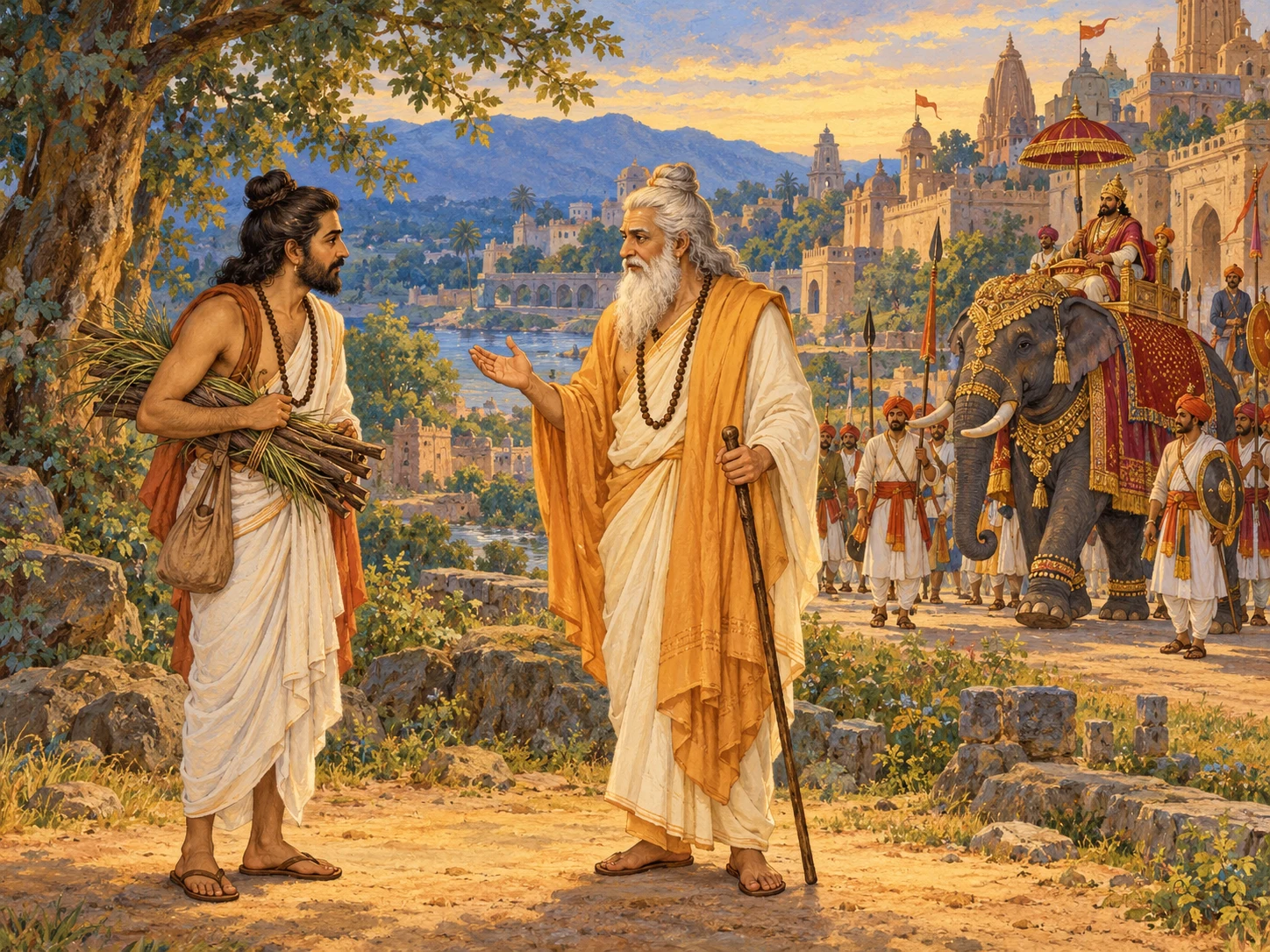
This time was outside, carrying firewood and sacred grass from the grove. His throat was dry. A king was entering the city, surrounded by attendants, and kept away from the crowd.
greeted him as though they were strangers. He asked why he stood apart. explained about the procession.
Which one is the king? the visitor asked.
pointed out the man seated on a great elephant. The people around him were attendants.
But you have shown me the king and elephant together, said . Tell me which is which.
The pupil explained that the elephant was underneath and the king above. The elephant carried the king. Surely that showed the difference.
The visitor asked him to explain the difference between above and underneath.
So climbed onto . Here is your answer.
I am above, like the king. You are underneath, like the elephant.
accepted the demonstration, then asked what it had left unanswered.
You are like the king, and I am like the elephant. But which one is "you"? Which one is "I"?
At those words, bowed at the stranger's feet. He knew his teacher now. That question about unity could only have come from .
The teacher confirmed it. He had come again to give his pupil a brief teaching about non-duality: the oneness beneath apparent divisions.
Then he departed. began to see all beings as himself, and the account says that he attained liberation.
slow down hereAbove and below had shown where two bodies were. His teacher's last question had asked him to look deeper than their places.