Long before reached , crossed the world in the flying chariot called Puṣpaka. He had taken it from his brother, the lord of wealth. Its great power seemed to answer his will: wherever he wished to travel, it carried him.
Then, near Mount , the chariot stopped. pressed on, but Puṣpaka would not move. He looked toward the mountain and wondered who had dared to stand in his way.
A small figure came to meet him. This was , an attendant of . told the king that was on the mountain and that no visitor, however mighty, could pass into his place now. It was a boundary, plainly spoken.
stared at and laughed at his face. The attendant did not step aside. He told that one day beings with the form of monkeys would rise against his strength and break his pride. heard the warning and ignored it.
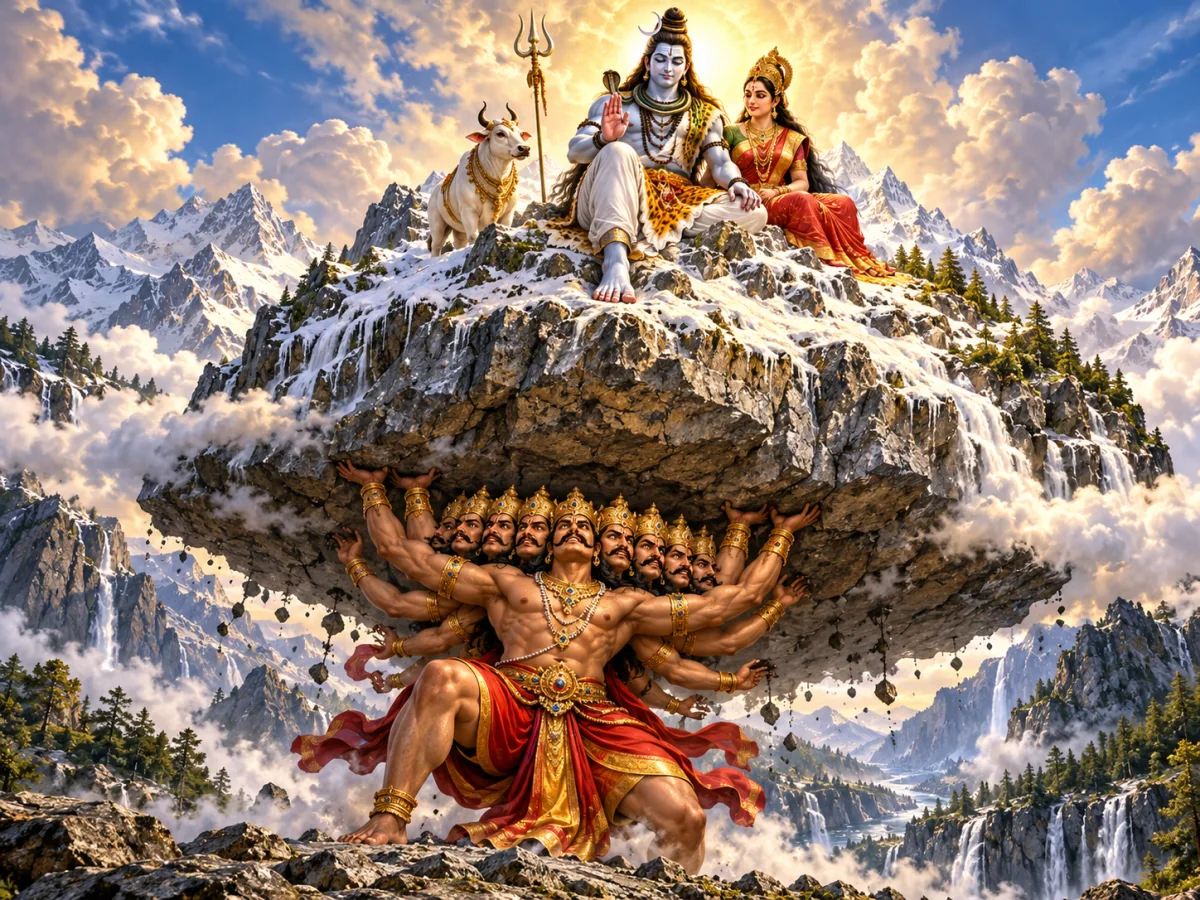
If the mountain would not let his chariot through, he said, he would uproot the mountain itself. He went to its foot, set his many arms beneath the rock and pushed. shook. Its heights moved. 's attendants were frightened, and clung to as the ground shifted around them.
did not have to gather an army. He pressed the mountain with one great toe. Down came , pinning 's arms beneath its weight. A moment earlier those arms had seemed strong enough to lift a home of gods. Now he could not pull them free.
cried out. The sound shook the three worlds. His ministers heard it and urged him to turn toward the one whose mountain he had tried to move. They told him to praise and seek release. The king could still roar, but a roar would not raise .
So began to recite hymns and sacred words. The telling counts a thousand years of praise before he is freed. His arms could not move the stone, but his voice went on. He had demanded a path across 's mountain. Now he asked the lord of that mountain to hear him.
At last was pleased. He lifted the weight from 's arms and praised his courage and endurance. He also gave him a name that would stay with him. The cry that had made the worlds tremble would be remembered in the name Rāvaṇa.
then asked for a boon. gave him a shining sword. The king bowed, returned to Puṣpaka and continued across the earth. His path was not finished. The Rāmāyaṇa will tell of the harm he does, and of the people who stand against him. This meeting does not erase any of that.
It is possible to be brave and devoted in one moment, and still need to answer for what one does in another. The scene does not ask us to pretend was only one thing. He could lift a mountain, mock the one who guarded it, and then spend an immense stretch of time praising the god who stopped him.
Nor does the story turn 's warning into an empty threat. Later, the monkey allies of will matter greatly in the struggle with . Here the warning lands before any of them appear. The king has heard a future he refuses to imagine.
What he can feel now is the weight of and the limit of his own arms. The mountain was not an obstacle placed there for his journey. It was 's dwelling, and had told him so. chose to treat another's boundary as something to tear away.
slow down hereThe toe presses down. The shouting changes to praise. Then the arms are freed. That is the turn this telling keeps in view: strength cannot make every place yours, and even a king who will later do wrong can be heard when he calls on with devotion.