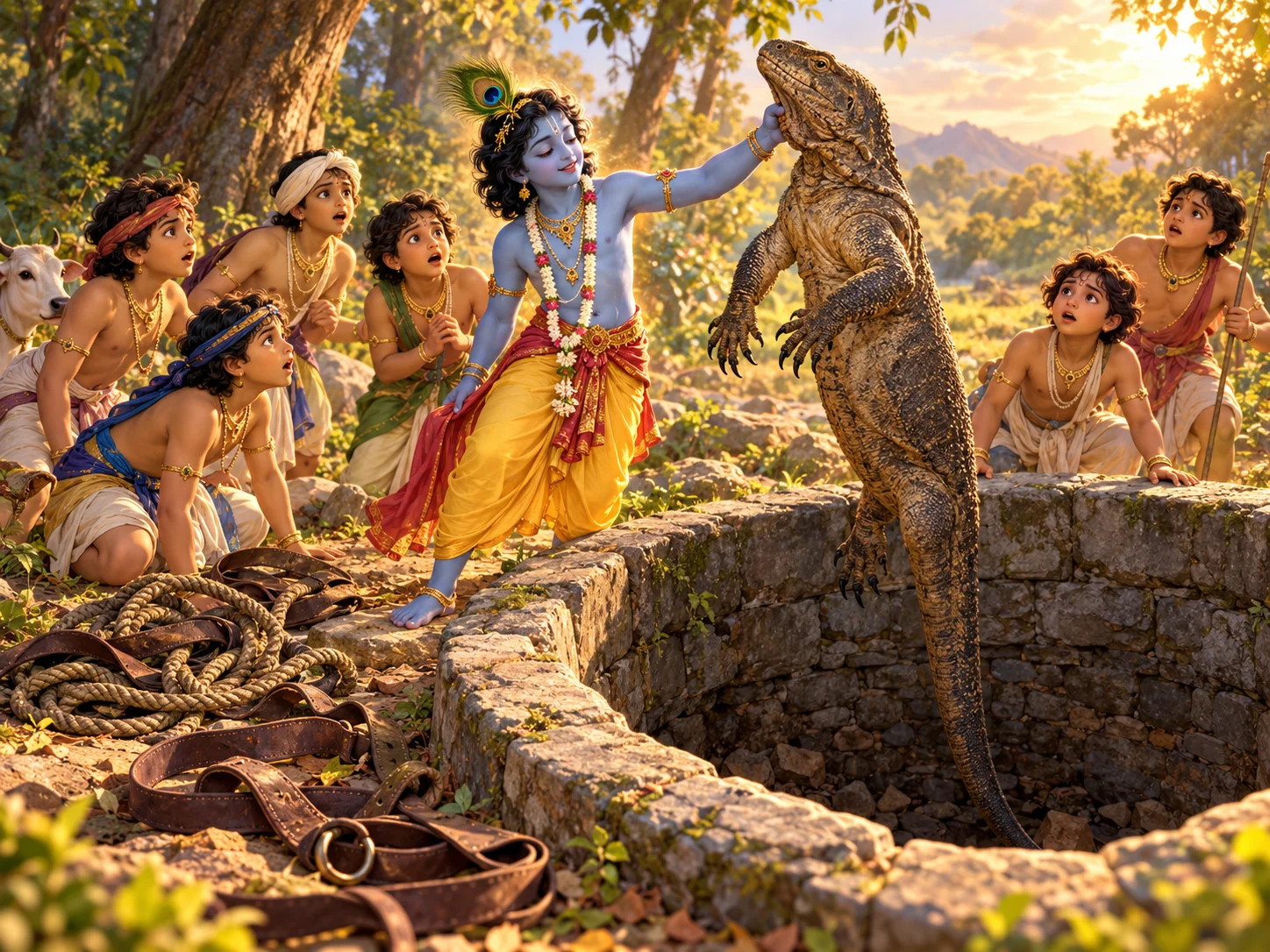
Sāmba, Pradyumna, and other Yādava boys played in a small forest until thirst sent them looking for water.
They found a well. It was dry. Far below sat a lizard so enormous it seemed almost as big as a hill. It could not climb out.
The boys wanted to help. First they tried leather straps. Then they tried woven ropes. They pulled and pulled, but the creature did not rise. At last they went to and told him what they had found.
came with them to the dry well. He looked down, reached in with his left hand, and lifted the great lizard out. The moment his hand touched it, the creature's form changed. A man stood there, clothed and ornamented like a being from heaven.
The boys who had struggled with the ropes could now see him standing beside the well.
knew more than he said, but he asked the stranger to tell everyone who he was and how he had come to be there. The man bowed. He was , once a king, a son of .
had given many gifts. He remembered cows with calves, cows whose horns had been gilded and whose hooves were covered in silver. He had given them to brāhmaṇas in need. How many cows? He spoke of numbers as great as the grains of sand or drops of rain.
But among all those gifts there had been one cow that was not his.
She belonged to another brāhmaṇa. She had strayed into the king's herd without knowing. When he gave cows away, he gave her to a second man. As that man led her home, her owner saw her. That is my cow, he said. The king gave her to me, replied the man who had received her.
The two men came before . Each had a claim to the same animal. One had lost his cow. The other had accepted a gift from the king. heard them and was bewildered. What could he do that would put this right for both of them?
He offered a hundred thousand of his best cows in exchange for that single cow. He asked both men to show him mercy. He had given her away without knowing she was another person's, he told them. But the man who had received her would not exchange her.
The original owner refused the offered cows too. Both left. Neither man gave way. had offered much, but the cow was still claimed by both.
Later died. 's messengers brought him before , who spoke of the many good results waiting for him from his gifts. Then gave him a choice: would he experience those good results first, or the painful result of the mistaken gift? chose the painful one first.
He fell into the body of a lizard. Yet he did not forget his earlier life. He remembered who he had been through that strange life.
And then came a day when some thirsty boys looked down into a dry well. Their ropes could not lift him, but 's hand did. Standing once more in a human-shaped, shining form, praised . He asked to depart. gave his permission, and bowed and entered a heavenly vehicle while the others watched.
spoke next to his companions. His warning was about the property of a brāhmaṇa, even when someone takes it without knowing. had been generous beyond counting, but he had also given away a cow that belonged to someone else.
had offered more cows than most people could count, yet he had watched both men walk away. The one disputed cow remained in his account beside all those gifts.
slow down hereThe well was empty of water. When the boys looked into it, they found a question that had followed there for a very long time.