The first strange thing was that the baby did not cry.
Everybody in the room was waiting for it, the way you wait for it, and it did not come. He was breathing and he was well and he was entirely quiet.
The second strange thing was that he would not feed. Not weakly — he was not a sick child. He simply had no interest in it, the way a person has no interest in dinner when they are in the middle of something.
The third was his eyes, which he kept shut.
His parents had wanted a child a long time and had gone to a temple and asked for one. Now they had him, and they sat and looked at him, and worked out something very hard to work out: he had not quite arrived here. He was somewhere else already, and full already, and looking at something already.
So they did the thing the story is careful to describe properly. They did not leave him anywhere. They carried him to the temple at , where they had asked for him, and they gave him back.
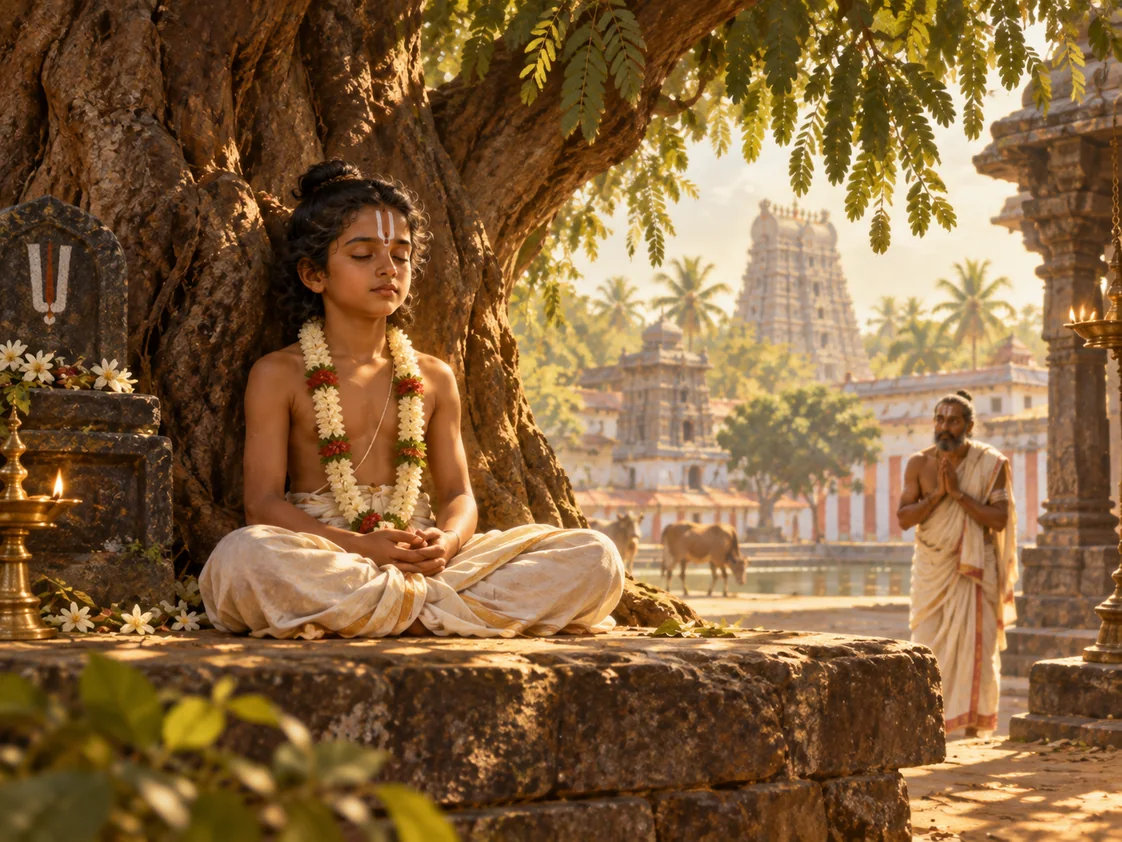
And they set him down at the foot of an old tamarind tree in the temple ground, in the town where they went on living.
He sat down under that tree. And then he sat there for sixteen years.
He did not speak in all that time, or eat, or sleep. He sat cross-legged with his eyes closed and the tamarind grew over him. The tree is still there and people still go and see it.
Children who were born after he sat down were sixteen by the time anything happened.
What happened came from about as far away as it could.
Far north, a man named was on pilgrimage — older, learned, a long time travelling, and Mathurā and all the northern places.
One night he noticed a light low in the southern sky. Not a star. It was in the same place the next night, and the night after, and on the fourth he stopped arguing with himself, turned round and walked south.
He walked south a long way, town after town, each time the light further on, until he came to a small place on the Tāmiraparaṇi river and it stopped and stayed.
And he looked, and under a tamarind tree in the temple ground there was a boy of sixteen sitting with his eyes shut.
Now here is the thing about , who is the older one, and the travelled one, and the one who has read everything.
He did not wake him. He did not introduce himself. He did not explain about the light.
He asked him a question — a hard one, the kind you would put to a teacher — because he had worked out within about a minute who was the teacher here and who was not.
If the small is born inside the great and lifeless, he asked, what will it eat, and where will it lie?
He meant the soul, which is small, inside a body, which is not alive by itself.
And the boy who had not made a sound in sixteen years opened his eyes and said six words back to him.
That it will eat. There it will lie.
The boy's name was Māṟaṉ, and nobody uses it. He lived to thirty-two — sixteen years silent, sixteen talking — and in the second half he made one thousand two hundred and ninety-six verses, and one of his four books is held to be the Tamil counterpart of the .
And the man who had walked from to ask him one question spent the rest of his life saying that he had no god of his own, only a teacher, and that this was enough.
slow down hereThey call him Nammāḻvār now — our own one. Not his name either. Something a whole people decided to call him.