The question the sages asked was not about the story. It was about the man. How does anybody come to be alive so long that he is the only one left at the end of everything?
, son of . He had sat still, keeping his vow, through six lifetimes of — which is not a figure of speech; it is the unit the book counts in.
grew worried about what a man might be gathering by sitting that still, and sent dancers and musicians and the spirits of spring to interrupt him. He did not move. It also did not go to his head, which is the harder part.
Then the Lord came to him in the twin form of two sages, and , and offered him anything he wanted.
And here is where the story turns, before anything has happened. He did not ask to live longer. He asked to be shown — the power by which everyone takes what they are looking at for the plain truth.
He was told: so be it.
It began on an ordinary evening while he was at his worship. A wind got up — an enormous one.
Then clouds with lightning in them and thunder behind it, and rain coming down in torrents. The four great oceans stood up and came over the land, with the things that live in them still in them.
The rain did not stop. It went over the low ground and then over the hills, and then there was no high ground anywhere to go over.
And in the whole of it there was one man, and nothing at all to swim towards.
This is the part the book spends its time on, and it is not grand.
Monstrous fish struck at him. The waves turned him until he could not tell one direction from another. Whirlpools took him down and let him go.
He was hungry. He was thirsty, in all that water. He was frightened, then sad, then so ill he could hardly hold his head up.
It went on for years nobody has ever counted. The thing to keep hold of is that he asked for this.
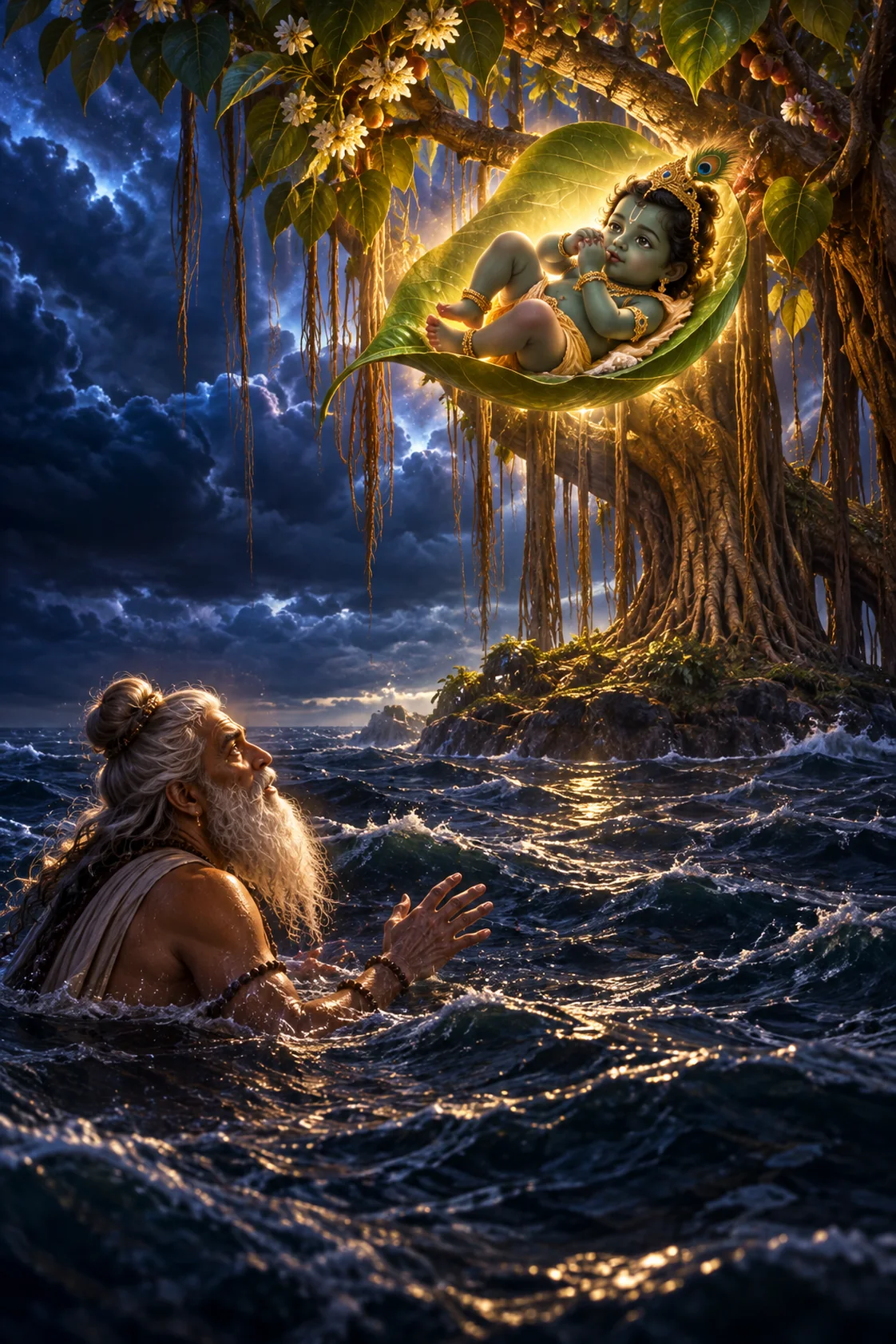
Then, after a very long time, a small rise of land — and on it a young banyan, in blossom and in fruit.
On a branch on the north-eastern side, lying in the cup of one leaf, there was a baby.
Dark as a flawless emerald, with a lotus face and ears like pomegranate flowers, and the light coming off him was swallowing the darkness all round him.
He had taken hold of one of his own feet in his fingers, and put a toe in his mouth, and he was sucking it.
And , who had been in that water longer than there are words for, stopped being tired.
The baby breathed in. And the breath drew him inside, the way a breath draws in a mosquito.
And inside there was the sky. The stars, the mountains, the oceans, the great islands, the directions going away on every side.
Forests and countries and rivers, cities and farming villages and cattle at pasture. People working. People at their worship.
And then the hills he knew. His own river. His own hermitage, and the ground in front of it where the two sages had stood.
The baby breathed out, and put him back in the water.
He saw the tree again, and the child again, and the child looked at him — a long, fond look — and he went towards him. And then there was nothing there.
And he was sitting in his own hut, on the bank of his own river, exactly as before.
slow down hereHe had asked to be shown how everyone takes what they see for the plain truth. What he was shown was a baby on a leaf with a toe in his mouth — and, inside the baby, his own house.