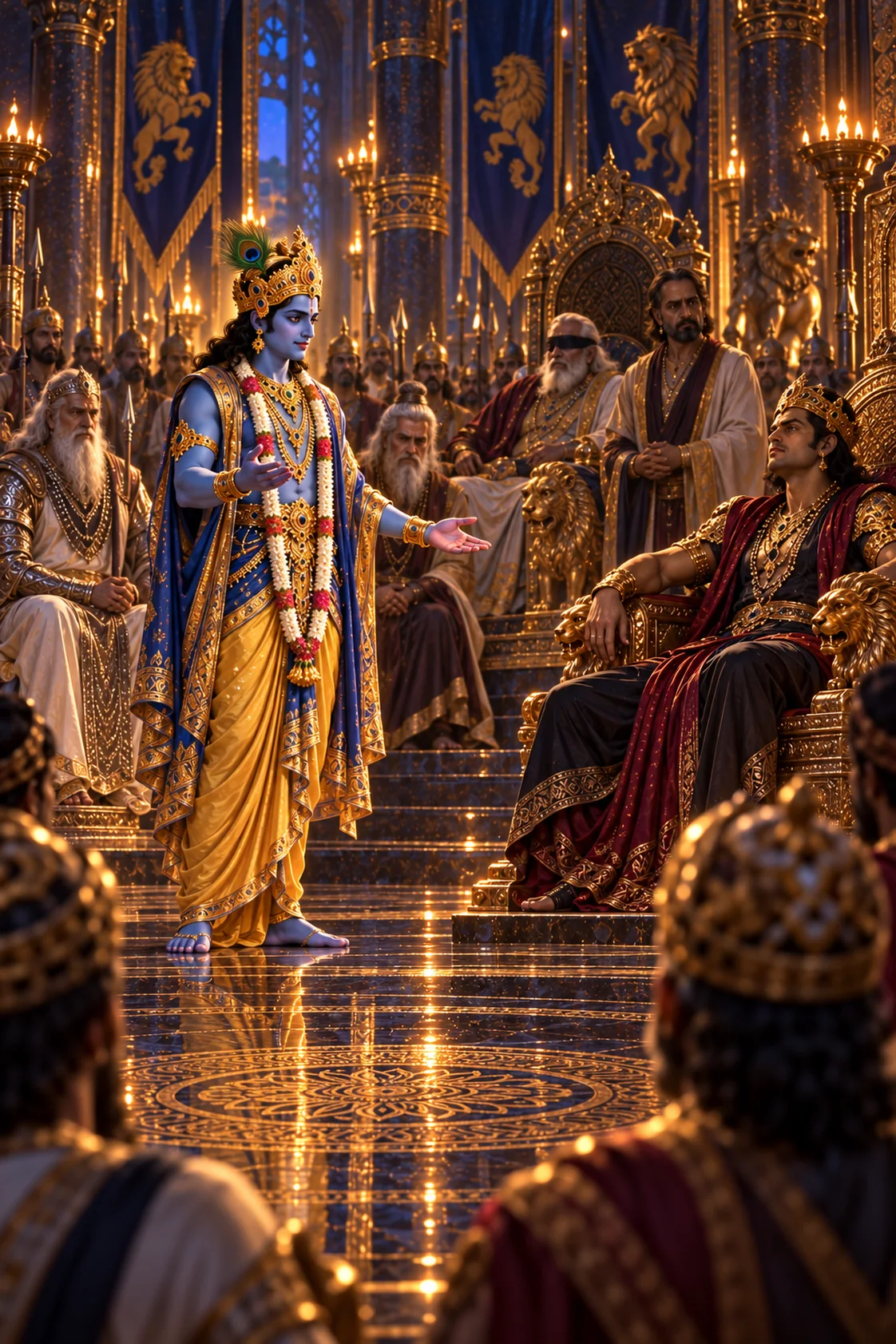
Thirteen years were up. Twelve of them in the forest and the thirteenth spent in hiding, and the five brothers came back and asked for what was theirs.
They had already asked once. had come from the old king, and sent his answer back with him. Not a kingdom. Five villages. Four of them named, and the fifth — pick any you like.
Give us five villages, he said, because we do not want this family destroyed.
And had answered it before anybody came, to his own father: he would not give up as much land as the sharp point of a needle could cover.
said he would go himself, for the sake of both sides. Then the room argued.
, of all people, spoke for peace. He asked to speak gently — not out of fear, he said, but to keep the family from being wiped out — and it startled everyone, as though the hills had lost their weight.
said peace was worth proposing, then said what he thought: advice given to that man is seed sown where nothing grows. wanted the war, and the soldiers round him roared when he said so.
And said: thirteen years I have kept this in my chest, like a fire that will not go out. Whatever else you do over there — remember my hair, and the hands that took hold of it.
He went. One night on the road, then .
He greeted the blind old king and first and the rest by age, then spent the afternoon with his aunt , who cried and told him what had been done to her sons.
invited him to dinner and he said no. A messenger eats at your table when his errand has worked, he said, not before; and a man does not eat the food of people who hate his friends. Not from anger, he said. Not from spite.
He ate at 's house instead.
And it was — who was on his side, who loved him — who told him not to go into the hall. They will not listen. Whatever you say in there is wasted.
And answered him. If a man does everything in his power to bring about a good thing and it comes to nothing, the good of the trying is still his.
And then, plainly, he added: having tried for peace, no king anywhere can blame me afterwards.
So he went in, on one side and on the other. Hold your own sons, he said, and I will hold the five. There can be peace, and nobody need be killed for it.
begged. begged. begged. The father begged his son in front of the whole court.
And said it to 's face, in front of all of them. Not as much land as the point of a sharp needle could cover. Then he walked out of the court.
, his own mother, was sent for, and he was fetched back in to hear her. He said the same thing again.
There was a plan to seize him and tie him up before he left. found out. said he would do nothing blameable in return.
at his forehead and at his chest. The guardians of the world along his arms, and fire and the gods out of his mouth. And round him — in a hall they were nowhere near — , , and the twins.
The frightened kings shut their eyes. , , , and the sages were given eyes to see it.
Then he walked out through the middle of them.
slow down hereHe came home and told them what he had said: that it was true, and reasonable, and good for the man he said it to, and that it had not been accepted. He had been told beforehand that it would not be. He said it anyway, so nobody could ever say it had not been asked.