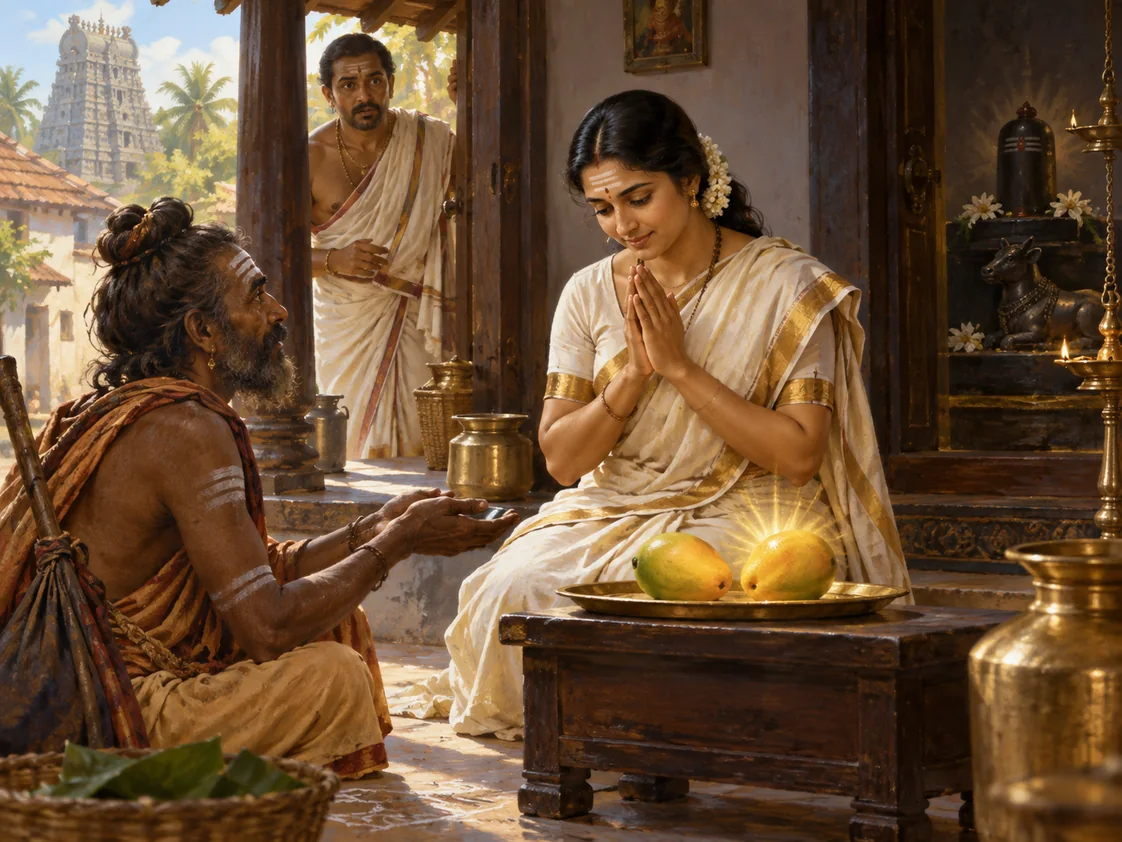
There was a woman in the town of Kāraikkāl, on the sea coast, and her name was . Her father was a merchant and so was her husband, and their house was a comfortable one.
One morning her husband was given two mangoes by a man he traded with. He sent them home ahead of himself, for his own midday meal, and went back to his work.
put them aside in the kitchen and went on with the cooking.
Then somebody knocked at the door.
It was a man who had been walking since morning, who wore the ash of , and who was hungry in the plain way a person is hungry when they have not eaten.
The rice was cooked. Nothing else was ready — the curries were not done, there was nothing to go with it. She looked at what she had.
She sat him down. She gave him rice, and she gave him one of the two mangoes, and he ate, and he was grateful, and he went on his way.
That is the whole of the story's argument, and it happens in the first four minutes. She fed the man at the door before her husband and before herself, and she did it with the best thing in the house.
Her husband came home at midday and sat down to eat. She served him, and she put the second mango on his plate.
He ate it and stopped eating.
Where did this come from? He had never tasted a mango like it in his life. Bring me the other one.
There was no other one. It had been eaten by a man walking to somewhere else, and her husband was sitting in front of her waiting.
So she went back into the kitchen, and she did not invent an excuse, and she did not cry. She asked for a mango — not as a prayer said at a shrine, but the way you ask somebody who is standing in the room with you and can hear you.
A mango came into her hand.
She looked at it a moment. An ordinary weight in her palm, and cool, with a stem on it as though it had come off a tree somewhere she had not been told about.
She carried it out and set it down in front of her husband, and he ate it.
And this one was not like the first, and it was not like any fruit that grows anywhere. He put it down. He asked her, carefully, where it had come from.
And she told him the truth, which was that she had asked for it and been given it.
Her husband was not a bad man and the story does not make him one. He is frightened, and what frightens him is not a trick or a lie — it is that the woman he married turns out to be somebody who can ask and be answered.
He could not go on living with her as a wife after that. He went away south, and made his life there, and when a daughter was born to him he gave her 's name, because he thought of his first wife as something holy and wanted the name in the house.
And , who had asked for one mango and been given it, now asked for something much larger, and it was given too.
They say she went north to , where is, faster than you can think it. And that she would not walk up the mountain, because to put her feet on it seemed wrong to her, so she went up the last of it on her head.
And watched her coming, and what he said when she arrived was one word: Ammai — Mother.
slow down hereSo nobody calls her any more. Everyone calls her the Mother of Kāraikkāl, because that is what he called her, and the name stuck.