Full · 6 min aloud
Earlier in the forest, had come to and and told them who he was.
He was a friend of their father, .
Jaṭāyu offered to stay near them. When Rāma and Lakṣmaṇa were away, he said, he would protect .
Rāma honoured the old bird, embraced him, and entrusted Sītā to his care.
Later, when carried Sītā away and the brothers were nowhere near, Sītā called to Jaṭāyu by name.
She asked him to tell Rāma and Lakṣmaṇa everything that had happened.
Jaṭāyu heard her cry.
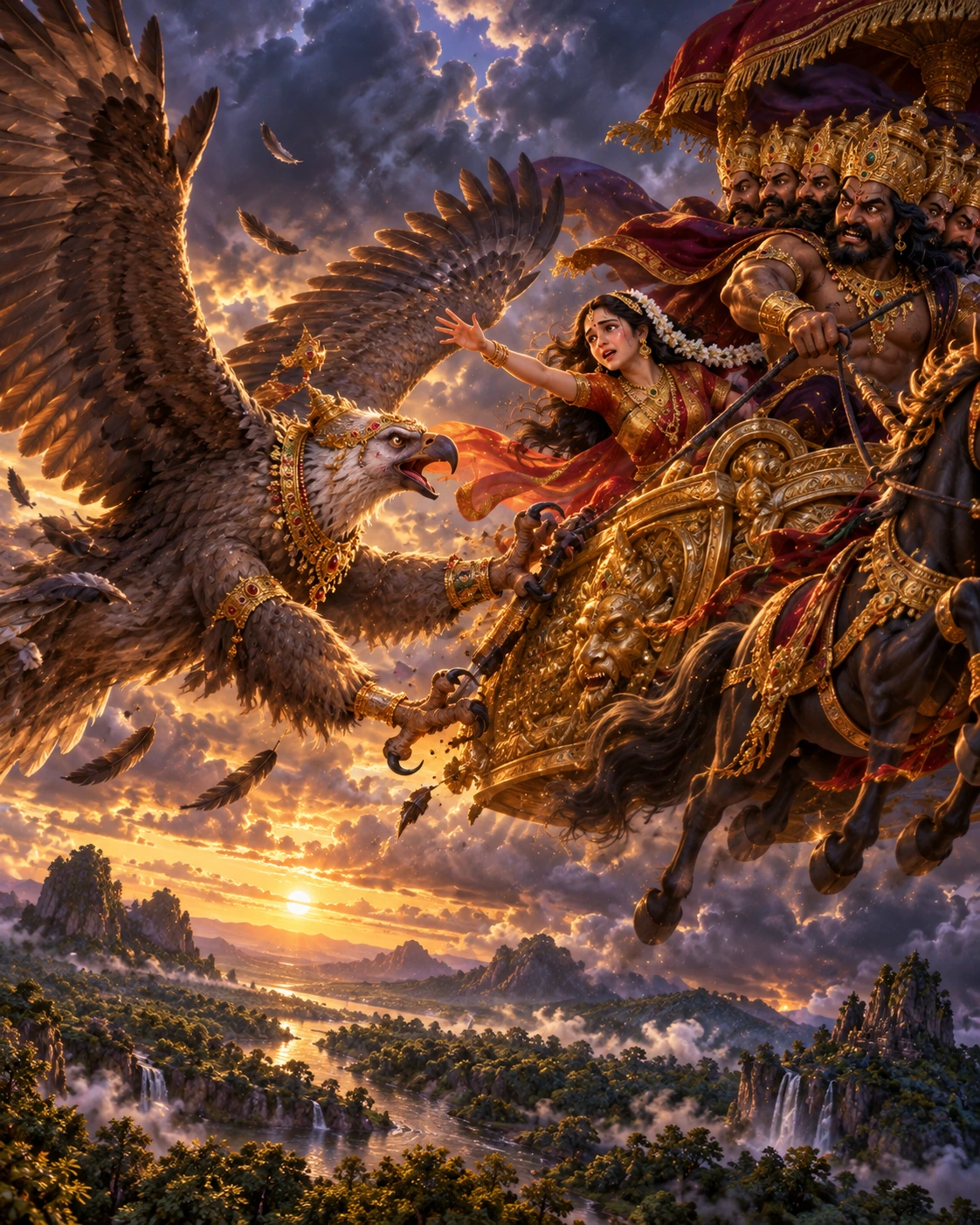
He saw Rāvaṇa carrying her away.
Jaṭāyu called out and told Rāvaṇa to stop. He said Sītā was Rāma's wife, and asked what wrong Rāma had done to deserve this.
Taking another man's wife, he said, was against dharma.
Jaṭāyu reminded Rāvaṇa that a king is supposed to protect, not violate, another man's wife. A wise man should not do what he would condemn in someone else. Rāma, he said, had done Rāvaṇa no wrong.
Release Sītā.
Jaṭāyu spoke plainly about himself too.
He said that sixty thousand years had passed since his birth. Rāvaṇa was younger, armed, armoured and riding in a chariot.
Rāma and Lakṣmaṇa had gone too far away for Jaṭāyu to bring them back in time.
So Jaṭāyu said, While I am alive, you will not take Sītā.
For Rāma, and for his old friend Daśaratha, he would act even if it cost him his life.
Rāvaṇa attacked Jaṭāyu with arrows.
The arrows struck him.
But when Jaṭāyu saw Sītā in Rāvaṇa's chariot with tears in her eyes, he rushed at Rāvaṇa again.
He wounded Rāvaṇa and broke his bow with his feet.
With his wings, Jaṭāyu struck away Rāvaṇa's armour.
Then he killed the creatures drawing the chariot and destroyed the chariot itself.
Rāvaṇa, still holding Sītā, fell to the ground.
The beings who saw Rāvaṇa fall praised Jaṭāyu.
Jaṭāyu had stopped the chariot completely.
But the Rāmāyaṇa says that age was exhausting him.
Rāvaṇa rose again with Sītā.
Jaṭāyu attacked again.
He landed on Rāvaṇa's back and struck him with his claws and beak.
The fight continued.
At last Rāvaṇa drew his sword.
He cut Jaṭāyu's wings, his feet and his sides.
Jaṭāyu fell to the ground with a little life still remaining in him.
Sītā ran to where he had fallen.
She embraced Jaṭāyu as she would a relative and wept over him.
Then Rāvaṇa carried Sītā away again.
Much later, Rāma and Lakṣmaṇa came to the place where Jaṭāyu lay.
At first Rāma did not recognise him.
Seeing the great wounded creature before him, Rāma thought he might be a hostile being.
Then Jaṭāyu spoke.
He told Rāma that Rāvaṇa had carried Sītā away.
He told him that he had fought Rāvaṇa.
The signs of that fight were still there.
Jaṭāyu pointed to the broken bow, the armour and the ruined chariot.
He told Rāma that Rāvaṇa had cut his wings after exhaustion had weakened him.
Now Rāma knew who lay before him.
This was his father's friend.
Rāma embraced Jaṭāyu and wept.
The Rāmāyaṇa says that Rāma touched him with the affection one gives a father.
Jaṭāyu still had words to give.
He told Rāma that Rāvaṇa had taken Sītā towards the south.
He told him who Rāvaṇa was: the son of and the brother of .
Rāma kept asking Jaṭāyu to speak.
Jaṭāyu died while Rāma was still asking him for words.
Rāma said that Jaṭāyu had given his life trying to help him.
He told Lakṣmaṇa that Jaṭāyu's death for his sake caused him immense grief.
Then Rāma said that Jaṭāyu deserved the same honour as Daśaratha.
Rāma prepared Jaṭāyu's funeral.
He placed the king of birds on the funeral pyre.
He cremated Jaṭāyu as one of his own relatives.
Then Rāma and Lakṣmaṇa went to the .
There, together, the two brothers offered water for Jaṭāyu.
slow down hereRāma gave his father's friend the honours of family.
Short · 3 min aloud
called out to .
was carrying her away, and and were far from her.
Jaṭāyu knew them. He was a friend of Rāma's father, , and he had already promised to protect Sītā when the brothers were away.
So the old king of birds called to Rāvaṇa and told him to stop.
He said Sītā was Rāma's wife. He said taking another man's wife was against dharma.
Jaṭāyu did not hide his age. Sixty thousand years had passed since his birth, he said, while Rāvaṇa was younger and armed.
Then Jaṭāyu said, While I am alive, you will not take Sītā.
For Rāma and Daśaratha, he would act even if it cost him his life.
Rāvaṇa attacked with arrows.
Jaṭāyu fought back.
He broke Rāvaṇa's bow, struck away his armour, killed the creatures drawing his chariot and destroyed the chariot itself.
Rāvaṇa fell to the ground.
But age was exhausting Jaṭāyu.
He attacked again.
At last Rāvaṇa drew his sword and cut Jaṭāyu's wings, feet and sides.
Jaṭāyu fell with a little life still in him.
Sītā ran to him, embraced him like a relative and wept.
Then Rāvaṇa carried her away.
Later, Rāma and Lakṣmaṇa found Jaṭāyu.
He told Rāma that Rāvaṇa had taken Sītā and that he had fought him.
Jaṭāyu pointed to the broken bow, armour and chariot.
He said Rāvaṇa had gone south.
Then, while Rāma was still asking him to speak, Jaṭāyu died.
Rāma embraced his father's friend and wept.
He said Jaṭāyu had given his life trying to help him, and that the bird deserved the same honour as Daśaratha.
Rāma prepared Jaṭāyu's funeral and cremated him as one of his own relatives.
Then Rāma and Lakṣmaṇa went to the and offered water for him.
slow down hereJaṭāyu's last words gave Rāma the direction Rāvaṇa had gone.