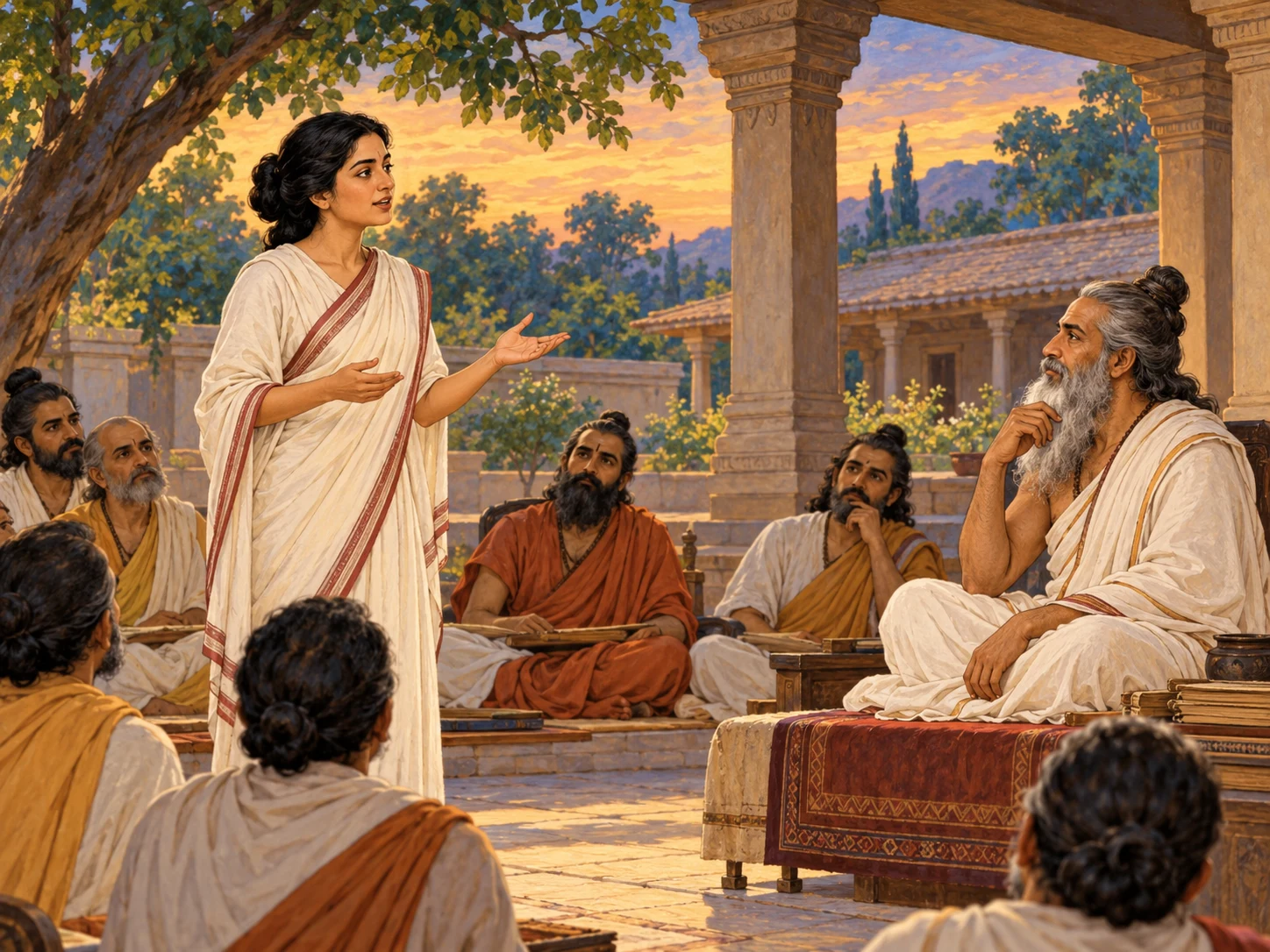
addressed the brāhmaṇas gathered for a discussion about Brahman. She was ready to put two questions to . If he could answer them, she said, none of those present would defeat him in an argument on that subject.
Ask, , said.
She pictured a warrior from or . He would string his bow and take two sharp arrows into his hands, ready for battle.
That was how she had come with her two questions. She asked to answer them.
She had named only two questions. The first would ask about everything in the world. The second would ask about the answer itself.
invited her to ask.
Ask, , he said, ready for her question.
Her first question began above heaven. It reached below earth and included everything between earth and heaven. Then it reached through time: all that had been, all that was, and all that was yet to be.
In what is all this woven, like threads crossing in cloth?
A cloth has threads running in two directions, holding together. 's question used that image for everything she had named. She wanted to know in what the whole was woven.
answered her in the same order. All that was above heaven, below earth and between them, all that was past, present and future, was woven in : space.
bowed to him. He had answered that question. Now, she said, he should prepare for the second.
Ask, , he said again.
She repeated what she had asked before: everything above, below and between heaven and earth; everything past, present and future. In what was it all woven?
Again, he answered: space.
The first answer had named space. It had gathered the whole question into one word.
But that word was not where stopped. She had another question for the one who had answered her.
Now came the next step.
In what, then, is space itself woven?
answered that the brāhmaṇas called it , the imperishable. It did not pass away.
He did not give her another large thing with a shape and a place. He spoke of what it was not.
It was neither thick nor thin, neither short nor long. It was neither red like fire nor fluid like water. It had no shadow or darkness, no air or space, no attachment.
It had no taste or smell, no eyes or ears, no speech or mind. It had no light, breath or mouth. It could not be measured.
It had no inside and no outside. It ate nothing, and nothing ate it.
Yet under its command, said, the sun and moon remained apart. Heaven and earth remained apart too.
Moments, hours, days and nights had their order. So did the half-months, months, seasons and years. Some rivers flowed east from the white mountains, others west or in other directions.
Under that same command, people praised those who gave. The devas and ancestors received the offerings made to them.
Then he spoke about knowledge. Even if someone made offerings, performed sacrifices and practised tapas for a thousand years, the result would come to an end without knowledge of .
He spoke of leaving this world without that knowledge, and of leaving with it. He called the person who knew a true brāhmaṇa. The teaching asked for understanding, beyond the length of a person's practice.
was unseen, yet seeing; unheard, yet hearing; not grasped by thought, yet knowing. There was no other seer, hearer, thinker or knower apart from it. In , he told , space was woven.
addressed the gathered scholars once more. They would do well to bow before him. No one there, she believed, would defeat him in an argument about Brahman.
slow down hereThen she held her peace. The question had gone from the world to space, and from space to what did not pass away.