and his brother had seized the powers and places of the gods. Even the shares that belonged to the gods in sacred offerings were taken. Displaced from heaven, the gods remembered the Goddess. She had promised to help when they called to her in distress.
They went to the Himalaya and began to praise her. They called to the one present in every being: as awareness, as understanding, as hunger and thirst, as the power to act. Their hymn moved from one form to another. Wherever they looked for her, they found another way to name her.
Again and again, the gods offered their greeting to her presence in all beings. They named sleep, shadow, patience, and peace.
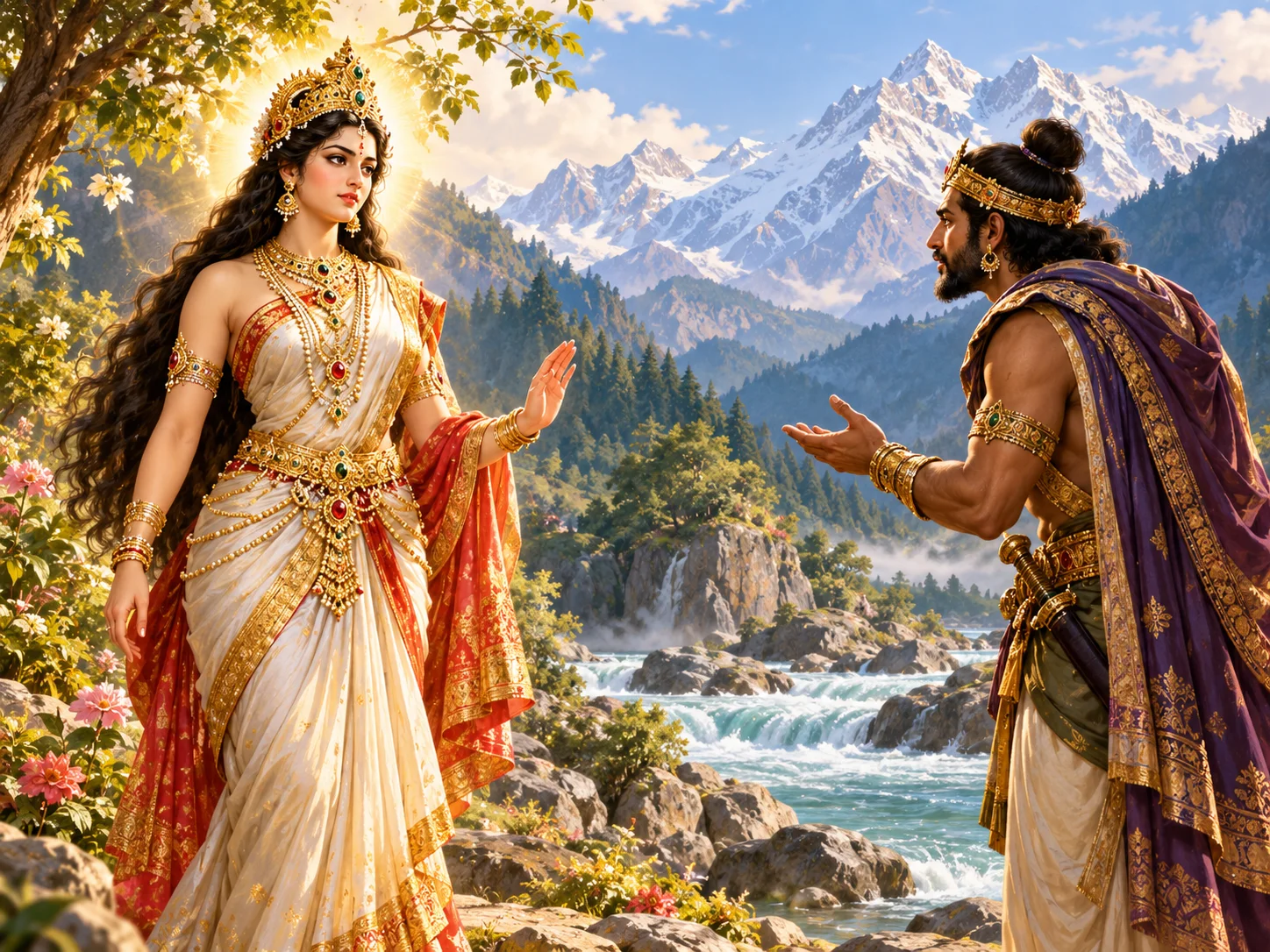
While they were praising, came to the Gaṅgā to bathe. She asked the gods whom they were calling. Then, from her body, a radiant form emerged. The hymn was for her. The text names this form .
Not far away, two followers of , and , saw the Goddess upon the mountain. They went to their lord with news of her beauty. They spoke of her light reaching across the directions. Then they began to count what already had. , the elephant once belonging to , was in his possession.
So was the horse . He had the heavenly pārijāta tree, a swan-drawn chariot, jewels and other treasures.
The two followers asked why the Goddess had not been taken as another prize. That was how they saw her: one more thing their lord might own.
They even named the ocean's garland of lotuses and garments that had given. In their report, everything had a place among 's possessions.
sent a messenger named . The messenger found the Goddess seated on a beautiful part of the mountain and began with smooth words. His master ruled the three worlds, he said. The gods obeyed him. held their offerings and their treasures. She should come to him.
If she preferred, she could choose his brother instead. There would be riches with either one.
The Goddess listened. She did not deny that the brothers were powerful. But she had made a promise, she said. The one she married would have to defeat her in battle, overcome her pride, and equal her strength. The messenger should go back and tell the brothers to come if they wished to meet that condition.
The messenger's smooth voice gave way to a threat. Did she think she could stand against those asuras? He belittled her for being a woman. If she would not go willingly, he said, someone would drag her by her hair.
The Goddess still did not change her words. She told him to report everything she had said. Then could decide what he thought right to do.
returned and gave his report. was angry. He called for , a commander, and ordered him to take an army to the mountain. He was to bring the Goddess by force, dragging her by her hair. If anyone tried to protect her, he was to kill them too.
set out with sixty thousand asuras. On the snowy mountain he found the Goddess and shouted that she must come to and . If she would not come willingly, he repeated, he would take her by force.
The Goddess answered him. He had been sent with an army, she said, and he was strong. If he took her by force, what could she do to him?
charged. Before he could seize her, the Goddess uttered one sound: huṃ. The commander became ash. His army had seen their leader run toward the one they had been told to carry away, and they had seen him disappear.
slow down hereThe battle had only begun. Here, on the snowy mountain, the messenger's boast and the commander's threat had both reached the Goddess. Her answer had not changed. No one had brought her to .