In the Pañcatantra, two travellers have been arguing about wanting more than one can safely reach. One tells the other about a brahmin who had not yet lost anything when his mind began to spend it.
The brahmin, , lived on what he could obtain by begging. One day he had barley-meal. He ate a portion and filled a jar with what remained.
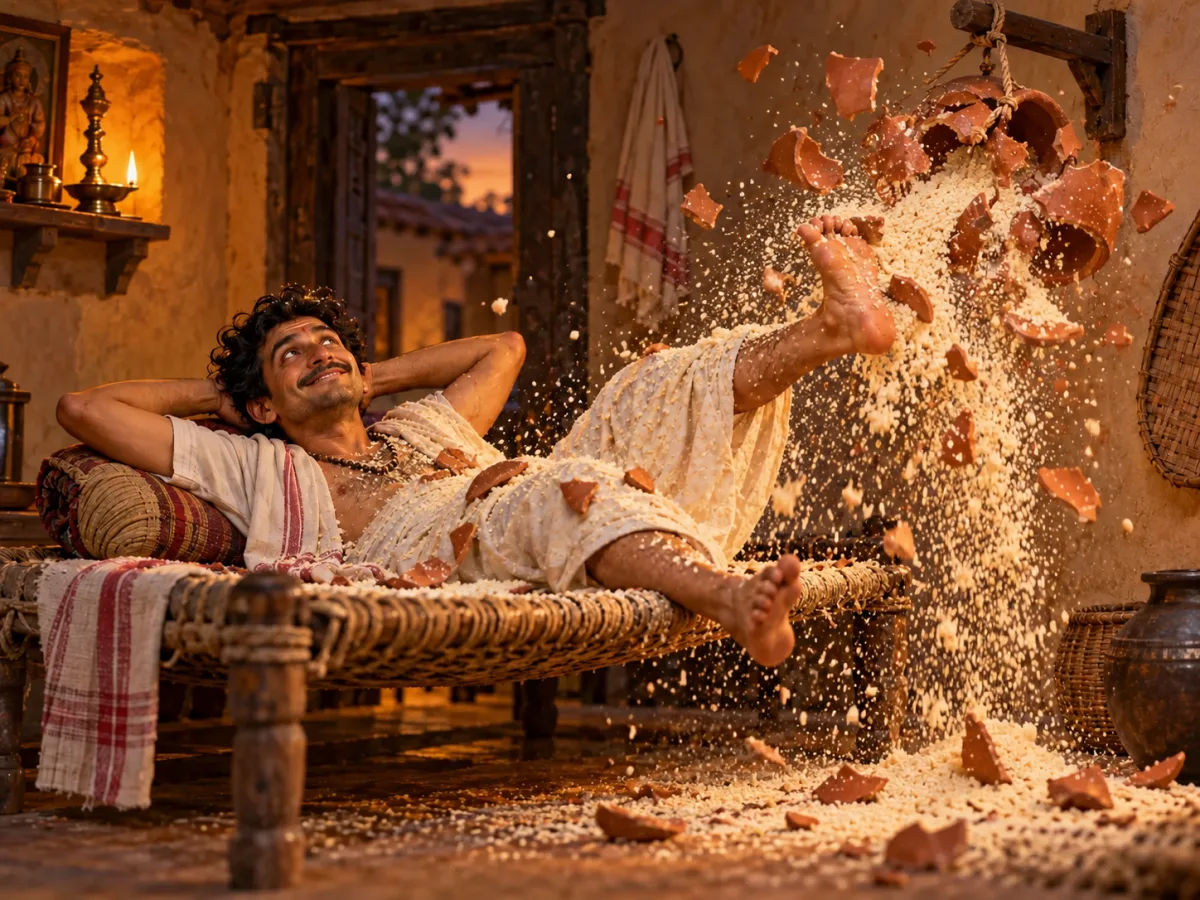
He hung the jar on a peg. Beneath it he placed his cot, so that when he lay down the meal was above him. He could see it from where he rested. That night he looked up at the jar and began to imagine what it might become.
If there is a famine, he thought, people will need food. I will sell the barley-meal for a hundred rupees. No famine had come. He had not sold the meal. Yet in his mind he was already holding the money.
With that money I will buy two she-goats. He imagined the goats bearing young. More goats would follow, and after enough births he would have a whole herd. He could then sell the herd and buy cows.
The cows would have calves. Selling the calves would let him buy buffaloes. Then he would trade again and buy mares. Each new animal existed only because he had already imagined selling the one before it.
The mares would bear horses. Horses would bring plenty of gold. He no longer looked at the jar as food for another day; in his thoughts it had become a long line of animals, each one turning into a larger purchase.
With the gold he would buy a great house. The Pañcatantra gives it an inner court. His dream had moved from a cot beneath one hanging jar to a home large enough for a family he did not yet have.
He imagined that someone would offer him a daughter in marriage. In the dream he married her, and they had a son. He even chose the boy's name: Moon-Lord.
The boy would grow old enough to ride on his father's knee. The brahmin pictured taking a book up to the stable roof and sitting there to read. The child, eager to reach him, would leave his mother's lap and come near the horses.
Now the imagined horses had hooves close to an imagined child. The brahmin thought he would call to his wife to take the boy away. In his dream she was busy with her work and did not heed him.
He imagined becoming angry. Rather than going to the child himself, he pictured rising and kicking his wife. This was not a wise or kind answer even inside the dream. It was the act his mind reached for while his real body lay on the cot.
The brahmin's leg moved. He kicked upward at the jar above him. It smashed. The barley-meal he had begged, eaten from and saved came down over him. It covered him so thoroughly that he was white all over.
He had not sold a single mouthful. He had not bought goats, cows, buffaloes or mares. There were no horses outside a stable and no gold waiting in a house. The wife and son had been people in a daydream, not people standing beside him.
Only the jar and its contents had been real, and they were broken and scattered. The chain of trades had needed a famine, a buyer, growing herds and one successful sale after another. His mind had stepped over all those uncertain parts as if they had already happened.
The traveller who tells the tale uses it to warn his companion against extravagant hope. The brahmin's loss comes at the exact point when the action in his dream reaches his sleeping body: he kicks, and the food on which the entire dream depended is gone.
slow down here had built a whole life out of one jar. Before any part of that life arrived, he kicked away the one thing he truly had.