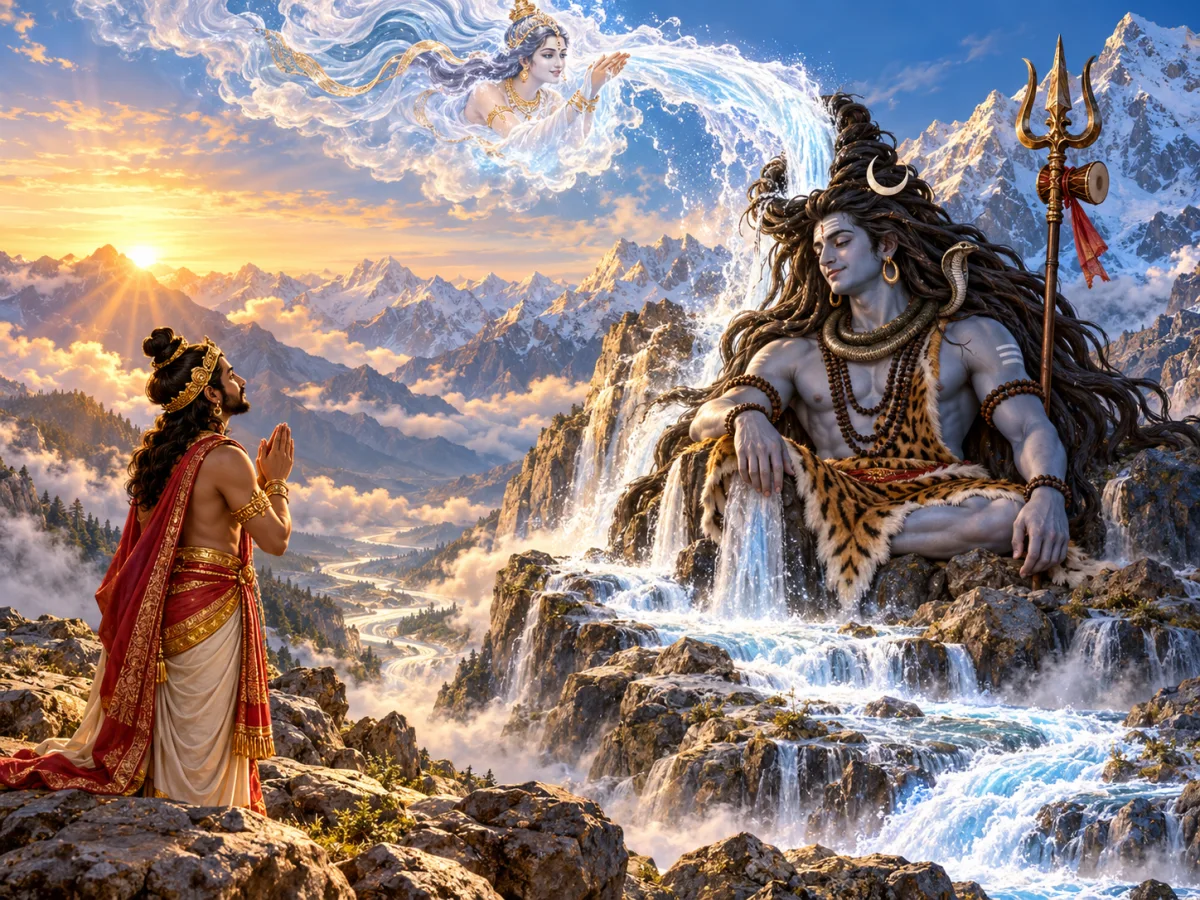
Long before was born, King 's sixty thousand sons had died far below the earth. Their ashes remained there. Water from could bring them release, but she flowed above the earth, beyond their reach.
's descendant learned what was needed. He hoped to bring the river down but died before he could. His son kept the task before him. He too died without seeing descend. Then 's son inherited a kingdom and an unfinished duty.
He left the kingdom in the care of his ministers and went to . There he stood with his arms raised and practised tapas for a long time, asking for the strength to finish what his father and grandfather could not.
had no child then, and the old duty was not the only thing on his mind. He wanted the family line to continue. Still, his first journey was away from the palace, to the place where he could ask for help with the river.
came with the gods and invited him to ask for a boon. joined his hands. He asked for 's water to reach 's sons. When it touched their ashes, they could go to heaven. He also asked that his family line continue.
agreed. Then he told the next difficulty. would fall from the sky with such force that the earth could not endure it. Only could receive her. One answer had brought to a new task.
So he prayed to . After a year, appeared and promised to bear on his head.
rushed downward. caught her in his matted hair. The river turned through the coils but could not find an opening. Years passed. saw that the water still had not reached the earth, and he prayed again.
released her into a lake. Six streams went east and west; a seventh followed . He rode ahead in his chariot, and came after him.
The water was full of life. Fish and other water creatures fell with it. People and gods gathered to watch. In one place the river ran straight; in another it bent; elsewhere it leapt upward and fell again. kept moving, because the ashes were still far away.
The sky shone with the ornaments of gods who came to watch. The river foamed white as she descended. Some people touched her water where it fell from ’s head; , however, could not stop at the first place where she reached earth.
The river reached the place where the sage was performing a rite. Her water flooded his offering ground. Angry, drank the whole river. Once more 's path had no in it.
The gods and sages honoured and asked him to release her. He did. flowed from his ears, and from that day she was called , the daughter of . She went on behind 's chariot.
They reached the ocean, then the world below it. saw the heap of ashes and was grieved. 's water covered the remains of 's sons. The Rāmāyaṇa says they were freed and went to heaven.
came again. He told that and had longed to do this but could not. He said would bear 's name, . then offered water for his ancestors as a family member does, and returned to his city. His people welcomed their king home.
called her because had brought her down. He also named her as a river of three paths, through heaven, earth and the world below. The name remembered a journey, not simply the king who asked for it.
slow down here could not finish it. could not finish it. inherited their wish, found a path for the river, and stayed with her until that path reached its end.