was a wealthy merchant of Pazhayarai in the Chola country. The Periya Purāṇam does not make his wealth the centre of his life. It remembers what he did with it: he fed devotees of and kept cloth ready for people who needed simple garments.
At Tirunallur, where a temple festival drew worshippers, he had established a place where devotees could eat and be cared for. One day a young brahmachari arrived there, wearing holy ash and carrying a staff from which two loincloths hung.
Amar-Nīti welcomed him. Before bathing, the visitor removed one of the two cloths and handed it over. Keep this carefully, he said. He would need it when he returned.
Nothing in the request seemed difficult. Amar-Nīti had built his service around this kind of need. A single piece of cloth was small next to the stores he managed, and he accepted the responsibility .
Amar-Nīti put the cloth away. But when the visitor came back from his bath and asked for it, the cloth was missing.
He searched the place where he had kept it. He asked the people around him. He looked through the stored garments. Nothing explained its disappearance.
The visitor was angry. Amar-Nīti apologised and offered another clean loincloth from his own stores. He could give many such cloths; giving them was part of his daily service.
But the visitor would not accept an ordinary replacement. The cloth that had been entrusted to Amar-Nīti, he said, had to be matched by something equal to it.
He still had the second cloth on his staff. Let that one be weighed, he proposed, and let Amar-Nīti give him an equal weight.
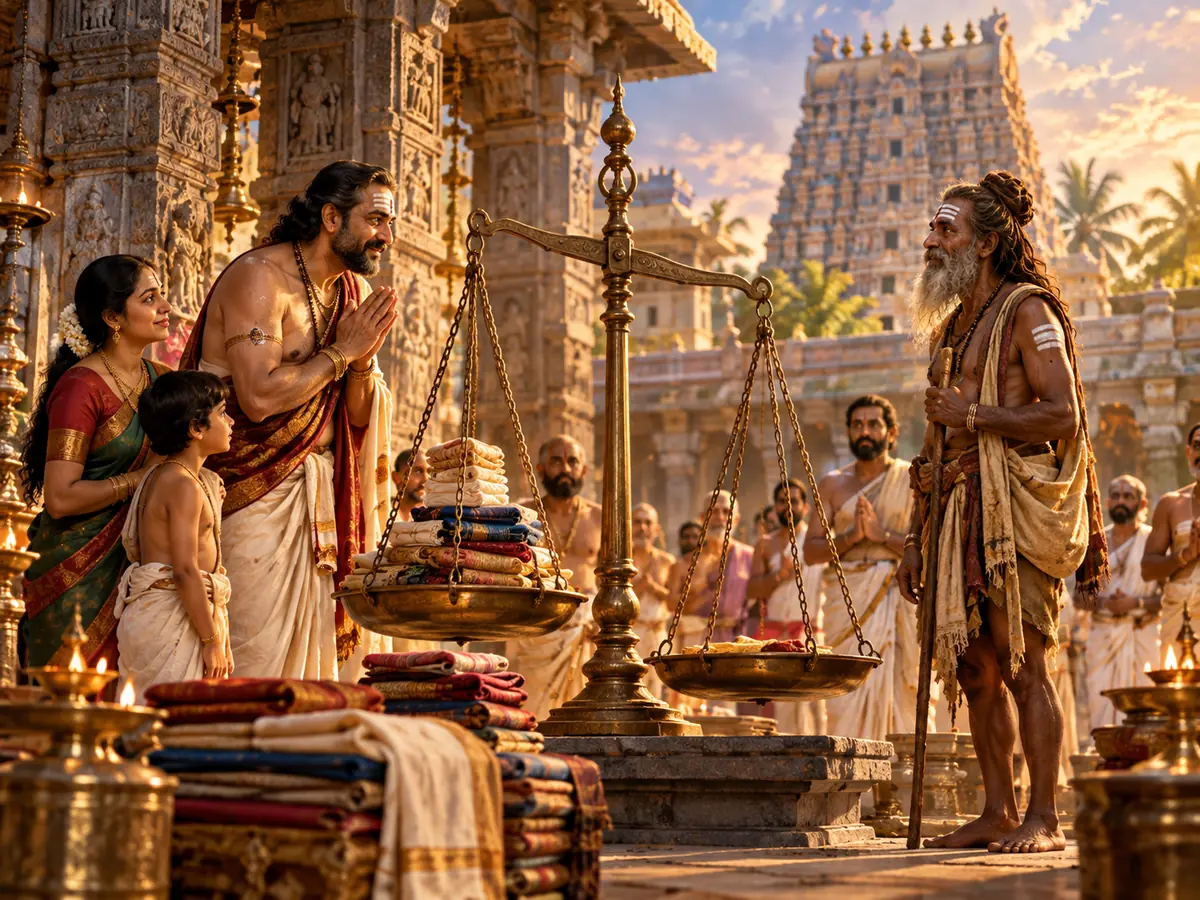
Amar-Nīti agreed. A balance was brought. The visitor placed his remaining loincloth on one pan.
Amar-Nīti placed a fresh loincloth on the other. It was too light.
He added another, and another. He brought out the many cloths he kept for devotees. The visitor's single garment still pulled its pan downward.
So Amar-Nīti added finer cloth and costly fabric. The beam did not level.
People gathered around as the pile grew. The scene became stranger with every addition: the visitor was not asking for luxury, yet one plain cloth outweighed a merchant's store.
He asked whether he might add other property. With permission, he brought gold, silver, jewels and the valuables of his household. Piece after piece went onto the rising pan.
The strange balance did not change its verdict. A small loincloth on one side remained heavier than the merchant's stored wealth on the other.
There was almost nothing left to offer.
Then Amar-Nīti asked for one more permission. Could he himself step onto the scale? His wife and son would come with him.
The visitor allowed it. Amar-Nīti, his wife and their son went around the balance in reverence. They prayed that if they had served and his devotees without deceit, the scale might now become level.
They climbed onto the pan with everything they had already placed there.
For the first time, the beam moved into balance.
The Periya Purāṇam then lets the disguise fall away. The young brahmachari was . The text says he appeared with the Goddess and blessed Amar-Nīti, his wife and their son.
The balance itself becomes part of the wonder in the hagiography: the family is carried onward in divine grace. Sandhya Katha keeps that ending as the Periya Purāṇam tells it, without turning the weighing into a rule for ordinary life.
The missing cloth matters because the crisis begins with custody: Amar-Nīti had promised to keep another person's belonging safe, and he would not treat that promise as disposable merely because he could afford a substitute.
The point is not that a person should surrender family or property whenever someone makes an impossible demand. The story is a saint's life, built to show the measure of Amar-Nīti's own vow of service.
slow down hereThe scale did not ask how much owned. In the story's final measure, the only thing heavy enough to stand beside his promise was the person who had made it.