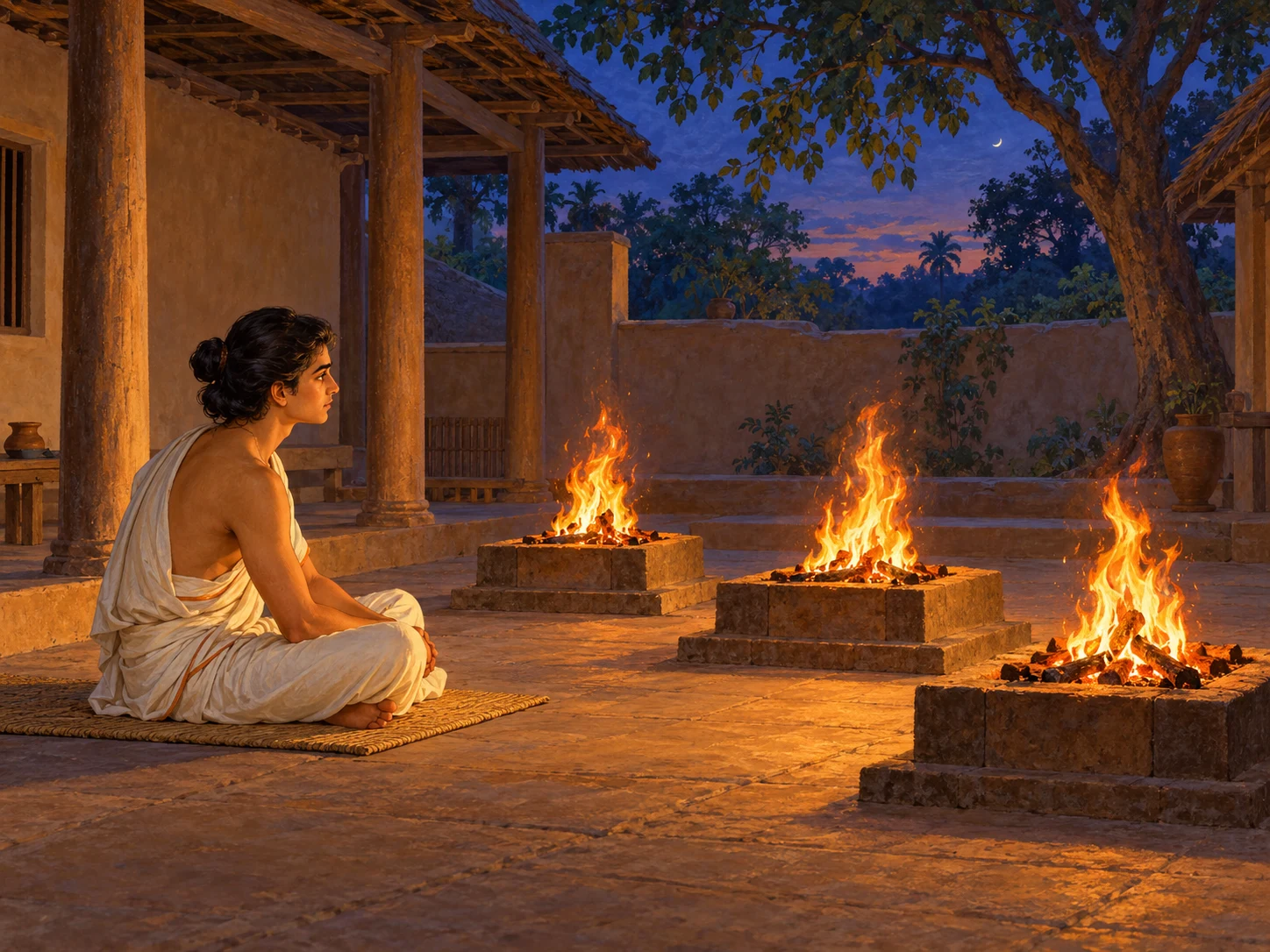
had been a pupil in the house of for twelve years. All that time, he had tended his teacher's sacred fires.
Other pupils were allowed to finish and return home. was not.
The teacher's wife noticed. She told that this student had worked hard and cared for the fires well.
Teach him, she urged. Do not let the fires blame you.
But went away on a journey without teaching him.
was troubled. He stopped eating. The teacher's wife spoke to him too.
Eat. Why are you not eating?
He answered that there were many desires in him, reaching in different directions. He was full of sorrow. He would take no food.
Then the fires he had tended spoke among themselves. They knew the care he had given them. Let us teach this student, they said.
They spoke of . Breath was , they said. So were ka and kha: words for joy and space in their teaching.
could have repeated those words. Instead, he told them where his understanding stopped.
I understand that breath is . But I do not understand ka and kha.
The fires answered that the joy they spoke of was that space, and the space was that joy. They taught him about breath and space together.
Then each fire gave its own teaching.
The fire, the household fire, spoke first. It named earth, fire, food and the sun. It spoke of the person seen in the sun, and said that it was that presence.
It also gave a promise. One who knew this and meditated on it would be protected here and in the other world. It spoke of freedom from wrongdoing, a full span of life, and descendants who would not perish.
These were promises to the person who knew and meditated on the teaching. was hearing about more than keeping a flame alight.
The fire spoke next. It named water, the directions, the stars and the moon.
It spoke of the person seen in the moon, and again identified itself with that presence. It too promised protection to the one who knew and meditated on this teaching.
Then the fire taught him. It named breath, space, heaven and lightning.
It spoke of the person seen in the lightning. Its teaching also carried the promise of protection in this world and the next.
Earth and food. Water and stars.
Breath and lightning. The three fires had each taught him, but they did not say that his learning was finished.
Together they told him, We have taught you about ourselves and the Self. Your teacher will teach you the way.
In time returned. He called his pupil by name. answered.
Your face shines like the face of someone who knows , the teacher said. Who has taught you?
pointed to the fires. His reply was brief. asked what they had said, and the pupil reported their teaching.
The teacher told him that the fires had taught him about the worlds. Now he would teach him further. He compared the effect of this knowledge to water on a lotus leaf: the water does not cling.
Tell me, asked.
spoke of the person seen in the eye as the Self: immortal, fearless, . He taught that all blessings came to the Self, that it led those blessings, and that it shone in all worlds.
Then he described the divine path after death, through light, day and the bright part of the month, through the six months of the sun's northward course and the year, onward through the sun, moon and lightning. A guide beyond the human leads the knower to , without returning to human life.
slow down hereThe student who had been left waiting was now receiving his teacher's instruction. Before it came, he had already found words for what he did not understand.