Before anyone was accused, there was only a jewel and a man walking into with sunlight on his chest.
was devoted to , the Sun-god. Sūrya gave him the jewel. It shone so fiercely that when Satrājit first entered the city wearing it, people ran to saying that the Sun himself had come to see him.
Kṛṣṇa looked and knew it was Satrājit. The jewel was not merely beautiful. The Purāṇas say that where it was properly kept it brought prosperity, and that it produced gold each day.
Kṛṣṇa asked Satrājit to place a treasure of that importance with King , the ruler of the Yādavas. Satrājit did not agree. He kept Syamantaka in his own household.
Then Satrājit's brother wore the jewel around his neck and rode into the forest to hunt.
He never returned.
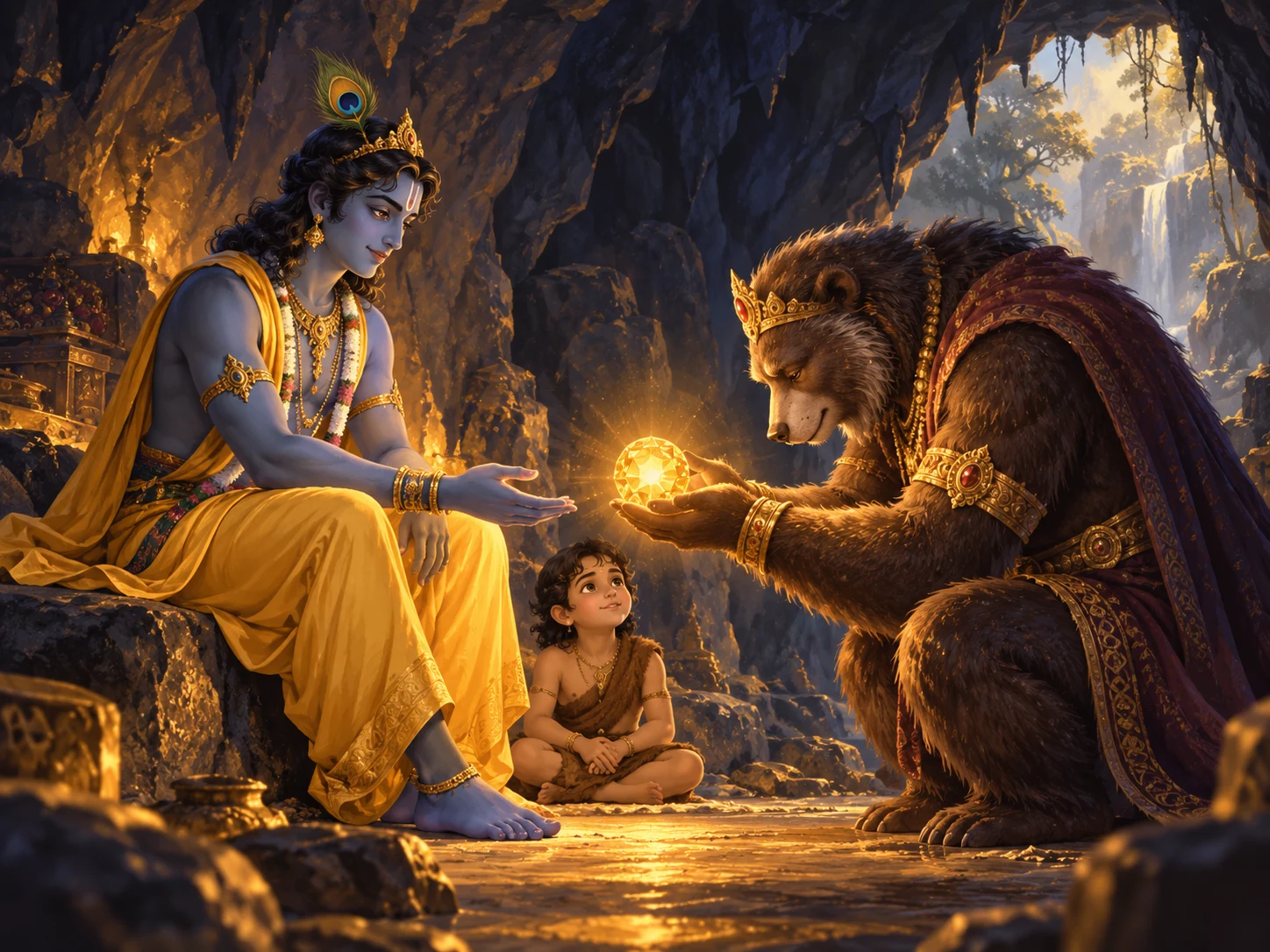
In the forest a lion had killed Prasena and his horse. The lion took the jewel. Then , the old bear-king who had served in 's time, killed the lion, carried Syamantaka into his cave, and gave the bright stone to a child there.
Nobody in Dvārakā had seen any of that.
What people remembered was something else: Kṛṣṇa had asked Satrājit to place the jewel with Ugrasena. Prasena had gone out wearing it. Now Prasena was dead or missing, and the jewel was gone.
The whisper began with Satrājit and travelled through the city. Perhaps Kṛṣṇa had killed Prasena for Syamantaka.
Kṛṣṇa could have answered that he had no need to steal anybody's jewel. Instead he chose the slower answer. He gathered people and went to find the evidence.
They found Prasena's body and the remains of his horse. Nearby were the signs of the lion that had killed them. Then they found the lion dead too.
That mattered. The first accusation no longer explained what lay on the ground.
From there another set of tracks led toward a cave. Kṛṣṇa left the others outside and went in alone.
The Viṣṇu Purāṇa preserves the clue he heard inside: a nurse calming a child with the story of the jewel — Prasena was killed by a lion, Jāmbavān killed the lion, and Syamantaka was now the child's plaything.
Kṛṣṇa found Jāmbavān. Jāmbavān did not at first know who had entered his cave, and the two fought.
The Purāṇas count the days differently. The Bhāgavata says twenty-eight; the Viṣṇu Purāṇa says twenty-one. What both tellings agree on is that the struggle went on for many days, until Jāmbavān's strength was exhausted.
Then recognition came. Jāmbavān understood that the one before him was the same Lord he had served in the age of Rāma. He stopped fighting and gave Kṛṣṇa the Syamantaka jewel. He also gave his daughter to Kṛṣṇa in marriage.
Kṛṣṇa returned to Dvārakā with the jewel. Before the people who had heard the accusation, he told the sequence plainly: Prasena, the lion, Jāmbavān, the cave. Then he placed Syamantaka back in Satrājit's hands.
Satrājit was ashamed. In the Bhāgavata telling he later offered Kṛṣṇa both his daughter and the jewel. Kṛṣṇa married Satyabhāmā, but he would not keep Syamantaka. The jewel went back to Satrājit.
That might have been the end. But another Purāṇic strand explains why this particular accusation is remembered on Gaṇeśa Caturthī.
The Mudgala Purāṇa says Kṛṣṇa had accidentally seen the Moon on Bhādrapada Śukla Caturthī and connects that sight with the false blame that followed. The Nārada Purāṇa likewise warns against looking at the Moon that night.
And if someone sees it by accident, the remedy those texts give is not to look again. It is to hear or recite the Syamantaka account — the story in which an accusation runs ahead of the facts, and the facts are patiently followed until they can be shown.
slow down hereSo when this story is remembered after an accidental glance at the Caturthī Moon, its last image is not the jewel shining. It is Kṛṣṇa returning it in public, with the whole trail finally visible.