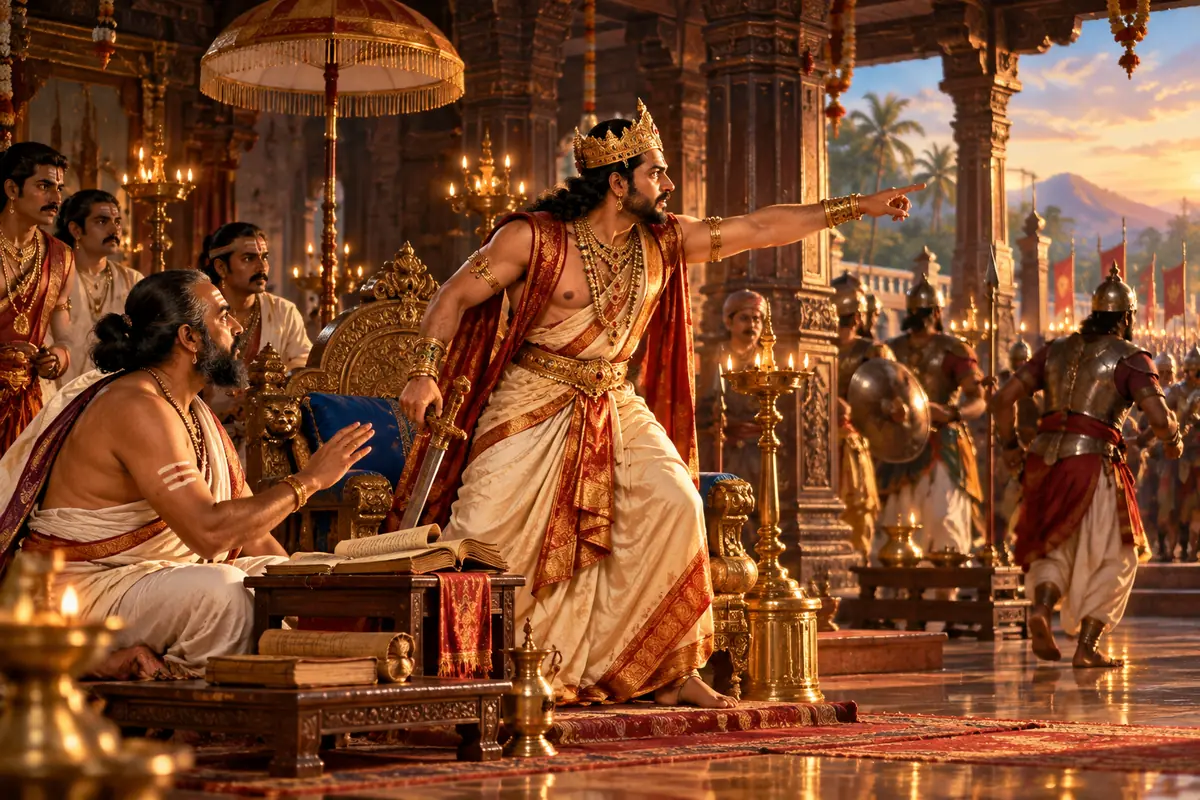
A king can command armies, settle disputes and decide what happens next in his own court. The later Śrīvaiṣṇava biographies of give him another habit: he listens to the Rāmāyaṇa until the distance between story and present time becomes dangerously thin.
Recitation in a royal hall should be simple enough. The teller speaks. The listeners know the ending. Whatever danger enters, everyone in the room knows he survived long ago.
Kulaśēkhara listens differently.
One day the reciter reaches the forest battle with Khara. is badly outnumbered. A huge rākṣasa force stands against him. The hall may know this as an episode; the king hears a military emergency.
To everyone else, the recitation described a danger that had already ended. To Kulaśēkhara, the duty of a king was still available in the room. If a friend was in danger and he had soldiers, then listening without helping made no sense to him at all.
He rises and begins giving orders. The army must be called. Soldiers must prepare. His forces will go to 's aid.
Nobody around him can solve the problem by saying, It is only a story. In the hagiography, that answer would miss exactly what is being shown. Kulaśēkhara has entered the telling so completely that loyalty demands action.
Yet obeying him literally would send a real army marching toward no battlefield it could reach. Ministers and reciter have to protect both the king and the kingdom without insulting the devotion behind the command.
One familiar solution is wonderfully practical. The reciter moves forward. He announces that has already won, that Khara and his forces have been defeated.
The king hears the victory and stands down. Relief arrives in the present tense. There is no longer anyone to rescue.
That is why the reciter's answer works without mocking him. He does not argue that the king should care less. He gives the devotion information: the battle is over, Rāma has won, and the help Kulaśēkhara was ready to send is no longer needed.
That is one version. The later hagiographic tradition is not perfectly uniform. Other tellings place the same impulse elsewhere, especially around the march toward the sea or Laṅkā, and remember Kulaśēkhara as repeatedly ready to take his own army into Rāma's campaign.
Sandhya Katha keeps that variation visible because the exact battlefield is less stable than the central image: a king hears the epic so intensely that he forgets the usual boundary between remembering loyalty and acting on it.
There is an older textual layer too. Kulaśēkhara's own Perumāḷ Tirumoḻi contains Rāma-centred decads that inhabit the feelings of the epic with remarkable closeness. In those poems, the Rāmāyaṇa is not distant material.
But the poem does not say, I once ordered my army into the story. That scene belongs to later biography. The poetry is the earlier witness to devotional identification; the hagiography turns that quality into a memorable royal incident.
There is comedy in the episode, but it is not a joke about a confused king. The people around Kulaśēkhara must take his command seriously because his concern is serious. They solve it by working inside the story-world he is inhabiting.
A child absorbed in a story sometimes shouts a warning at a character who cannot hear. The hagiography gives that impulse to a king with actual soldiers waiting for orders. Suddenly being inside a story has consequences.
Kulaśēkhara's problem is not that he cannot understand fiction. The tradition wants to show the opposite kind of excess: he understands loyalty so personally that the epic's danger becomes a demand placed on him.
The reciter's task is therefore unusual. He is not merely telling what happened next. For a moment, the next verse is also how he stops an army.
slow down hereThe court heard an ancient battle. heard a friend in danger—and reached for the power he actually had.