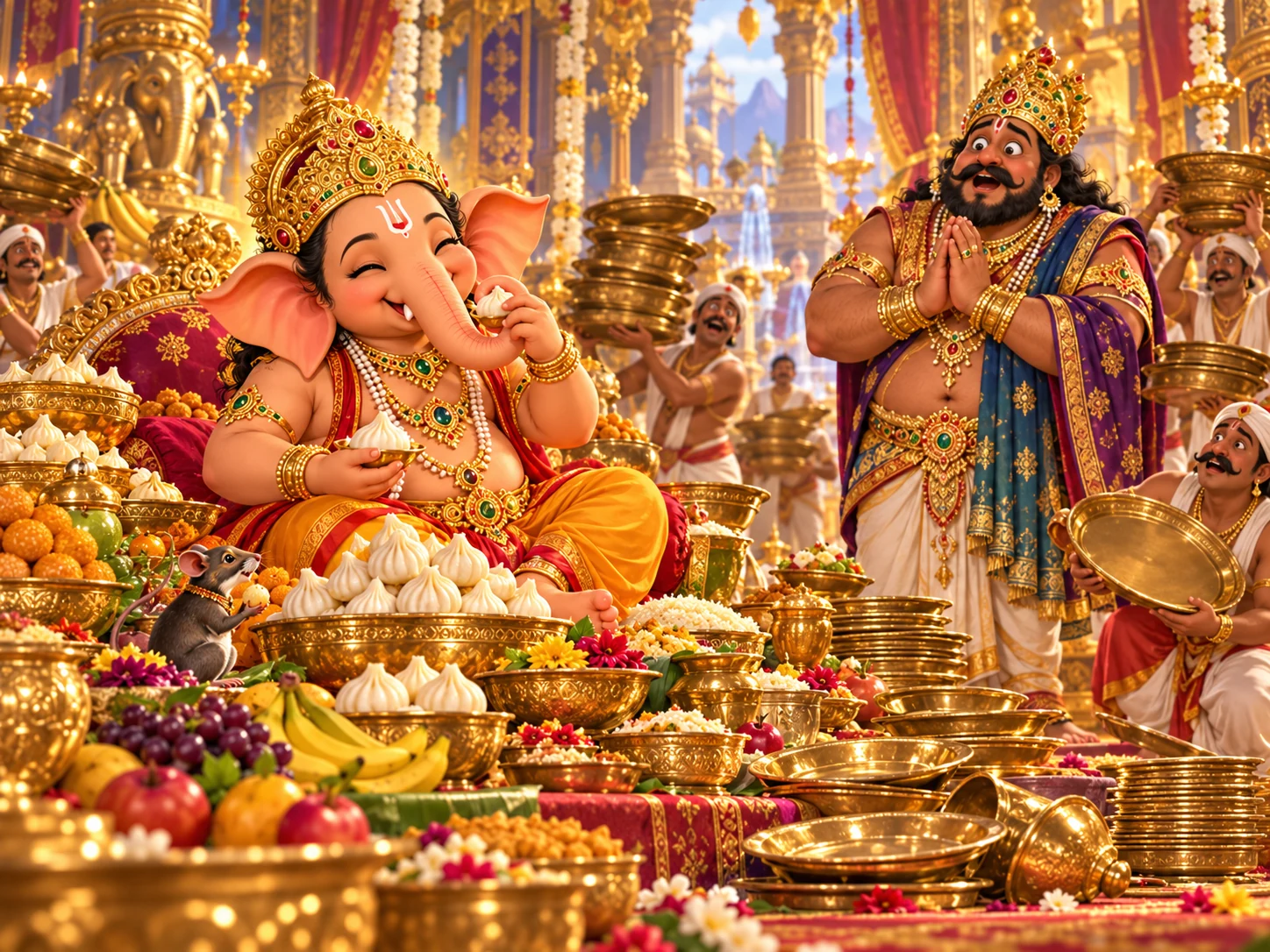
Kubera was known for wealth. In the popular Gaṇeśa story we are following, that wealth had become something he wanted other people to notice.
So he planned a feast large enough to display it.
A great hall was prepared for gods and other guests. Food was made in abundance. Kubera wanted the scale of the meal to say something about the scale of the person providing it.
He went to invite Śiva and Pārvatī personally.
They did not come themselves. Gaṇeśa was sent in their place.
Kubera looked at the guest and remained confident.
Whatever appetite Gaṇeśa brought with him, Kubera had kitchens. He had cooks. He had servants carrying vessels in and out. He had food prepared for a gathering, not just one child.
Gaṇeśa arrived hungry.
The first set of dishes was served.
He ate it.
A second helping came.
He ate that too.
Then another.
The story keeps repeating the same motion until repetition becomes the joke and then the problem: food arrives, Gaṇeśa eats it, and he is still hungry.
The servants returned to the kitchen.
The cooks sent out more.
Food prepared for the larger gathering was consumed. The other guests had not yet been fed, while Gaṇeśa's plates kept emptying.
In the modern witness chosen for this draft, he eventually moved toward the kitchen itself and consumed what had been kept there.
Kubera had arranged the feast so that nobody could miss his abundance.
Now nobody could miss that the abundance was running out.
His wealth was becoming a public problem instead of a public triumph.
Gaṇeśa remained hungry.
Kubera could order another plate, but not an endless one.
He could command servants, but not command the appetite in front of him to become satisfied.
The boast hidden inside the feast had reached a limit.
Kubera left and returned to Śiva and Pārvatī.
He admitted that he could not feed Gaṇeśa enough.
Pārvatī did not answer by giving him a greater treasure or a secret storehouse.
In the telling we are following, she gave him only a few grains of rice.
The new offering was almost absurdly small beside the banquet already eaten.
But Kubera was instructed to change the manner of giving.
He was to return without the pride that had turned hospitality into display, and to offer the small portion with humility.
Kubera went back.
This time he did not arrive as the richest host proving what he could afford.
He bowed.
He offered the few grains with respect.
Gaṇeśa accepted them.
His hunger ended.
The final portion was not materially better than everything that had come before it. It was smaller than almost any serving in the feast.
The person offering it was different.
That reversal is why this story survives so well in children's and oral telling.
A god of wealth discovers that wealth cannot perform every job simply by becoming larger.
A feast meant to demonstrate abundance fails, while a tiny offering succeeds once it is no longer being used to demonstrate the giver.
The popular story ends with Kubera relieved rather than triumphant. He has not found a richer food than the banquet. He has stopped using the meal to measure himself against the people he invited.
The guests and servants matter to the shape of the lesson too. Kubera's pride was public, so the failure of the feast became public. The story does not let him privately discover humility while everyone else continues admiring the display.
He has to leave the hall, ask for help, return with something tiny, and approach the same hungry guest in a different spirit.
That is why the last few grains do not function like a magic recipe. If another rich host copied only the quantity while keeping the same pride, the point of the telling would disappear.
The smallest thing on Kubera's table becomes enough only after the largest thing in the room — his pride in being the giver — becomes smaller.