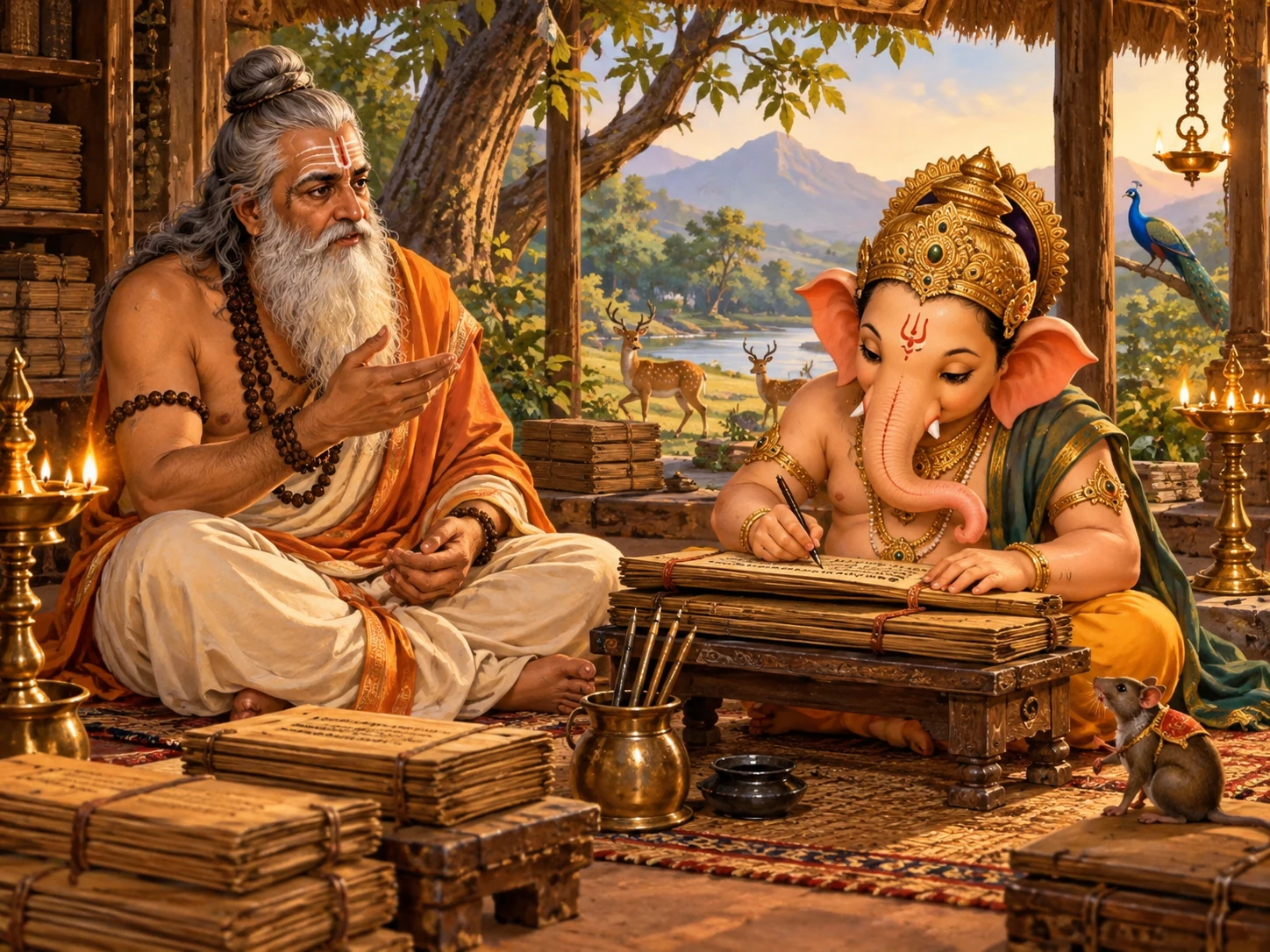
Vyāsa had formed an enormous work in his mind.
The transmitted Mahābhārata opening preserved in the Ganguli translation presents a practical question inside that grand claim: who could write while Vyāsa recited?
The story first has Brahmā speak to Vyāsa about the work.
He praises Vyāsa's knowledge, calls what he has made a poem, and says that no poet's work will equal it.
Then he gives one piece of practical advice.
Think of Gaṇeśa for the writing.
Vyāsa does.
Gaṇeśa appears and is received respectfully.
Vyāsa asks him to become the writer of the Bhārata that has already been formed in his imagination and that he is about to recite.
Gaṇeśa agrees, but not without setting a condition.
Once he begins, his pen must not cease writing.
That condition puts pressure on the poet. A long pause in composition would break the arrangement.
Vyāsa answers with a condition of his own.
Gaṇeśa must not continue writing anything he does not understand.
Gaṇeśa accepts with an Om.
Now the task has two rules at once: the flow of writing must continue, and understanding must come before inscription.
Neither rule cancels the other.
Vyāsa begins.
The source then explains how he creates room for composition while keeping his agreement.
He makes some verses densely constructed and difficult in meaning.
Gaṇeśa cannot simply race across them.
Because of Vyāsa's counter-condition, the scribe has to understand before writing.
So he pauses to consider the tightly knotted verse.
During that thinking time, Vyāsa continues composing what will come next.
The passage goes on to speak of eight thousand eight hundred especially difficult verses.
Its narrator says that their meaning is mysterious and hard to penetrate, known fully only to a very small number.
Even Gaṇeśa, extraordinary enough to keep pace with Vyāsa's recitation, is described as taking time to consider them.
The tale therefore gives thought a visible place inside speed.
Fast writing is not enough.
Fast speaking is not enough.
The work continues because one person cannot rush the other past understanding.
There is a useful symmetry in the two conditions.
Gaṇeśa protects the poem from endless hesitation: keep speaking.
Vyāsa protects the writing from empty speed: understand first.
Each person's strength becomes the other person's boundary.
That is why the scene works even before anyone asks whether every detail is historical or symbolic.
It is a story about the discipline required to carry something enormous from a mind into words.
The source label must be exact.
This Gaṇeśa-as-scribe episode belongs to the transmitted Mahābhārata tradition and appears in the Ganguli vulgate opening, but the Bhandarkar Critical Edition did not include it in its constituted text.
And the chosen passage does not say that Gaṇeśa broke off his tusk when a pen failed. That famous image belongs to later popular retelling.
So our illustration uses an ordinary stylus, and our story keeps the older scene to the two conditions, the difficult verses and the thinking pauses.
The passage is also careful about who knows the difficult verses. Its narrator says he knows the eight thousand eight hundred; Śuka knows them; perhaps Sañjaya does. The point is not that they are meaningless riddles, but that their meaning is unusually hard to penetrate.
That distinction protects Vyāsa's counter-condition. He is not cheating by inserting gibberish. He is composing verses dense enough to demand the very thing he required from his scribe: comprehension.
Gaṇeśa's condition and Vyāsa's condition therefore keep meeting on every difficult line. The pen must continue, but only after the mind has caught up.
A child who is proud of finishing first can hear a different measure of intelligence here. Sometimes the quickest useful response is not the first mark on the page. It is the moment you refuse to write what you have not yet understood.
Gaṇeśa's hand is asked to move without stopping, but his mind is never given permission to hurry past what it does not understand.