On the bank of the Sarasvatī, a group of sages performing a sacrifice fell into an argument.
Which of the three great deities — Brahmā, Śiva or Viṣṇu — was greatest?
The Bhāgavata Purāṇa says they sent Bhṛgu, Brahmā's son, to find out.
Bhṛgu did not conduct the test politely.
He seems to make each provocation stronger than the one before it.
He went first to Brahmā's court.
A son would normally greet his father with honour. Bhṛgu deliberately did not bow and did not offer praise.
Brahmā became angry.
The text says anger rose within him, but he controlled it.
Bhṛgu left without explaining the test.
Then he went to Kailāsa.
Śiva was glad to see him and rose to embrace his brother.
Bhṛgu refused the embrace.
He insulted Śiva with words the text presents as deliberately offensive.
Śiva's anger flared. His eyes burned and he raised his trident.
Pārvatī intervened, fell at Śiva's feet and calmed him.
Bhṛgu left again.
His third visit was to Vaikuṇṭha.
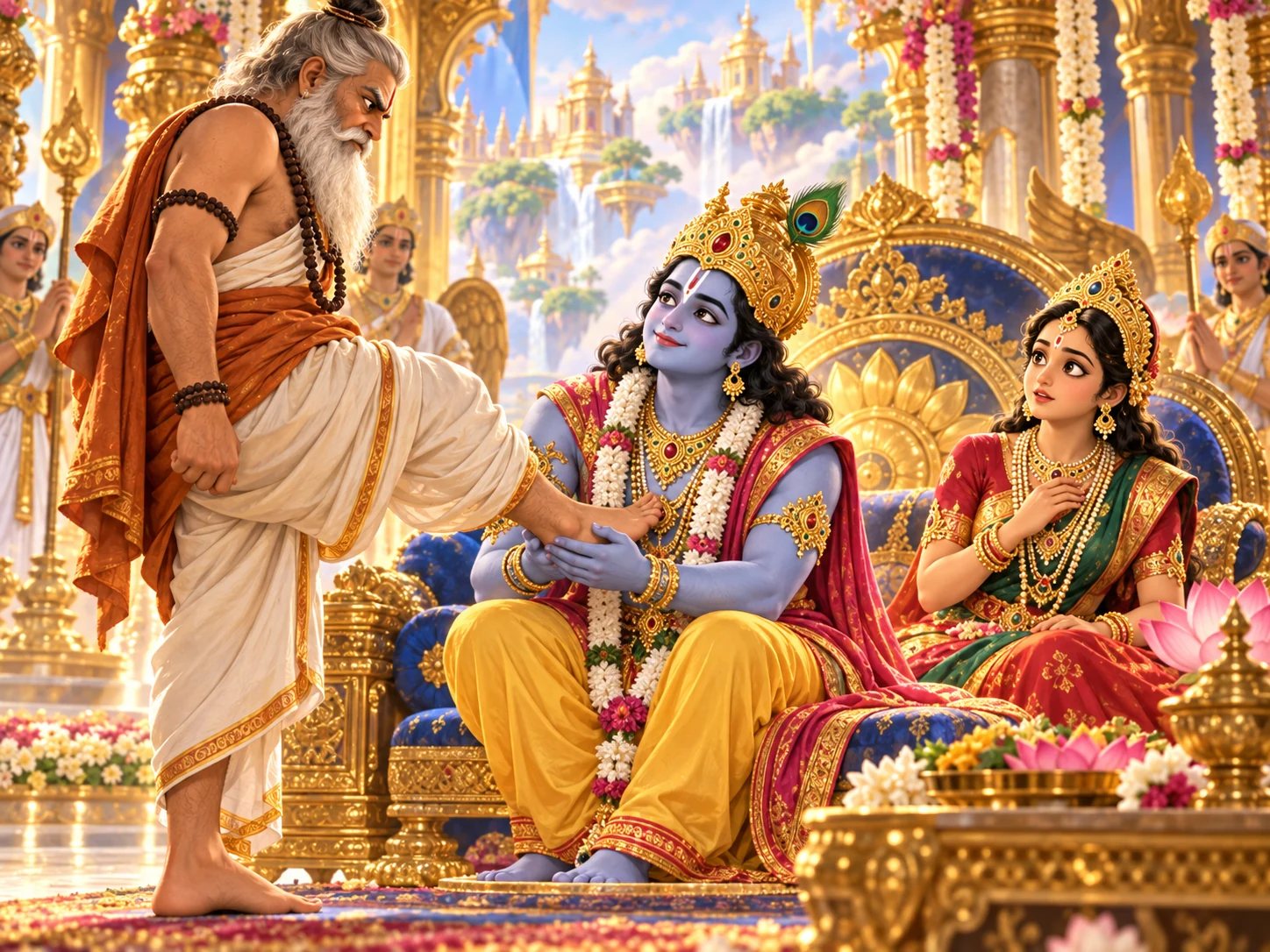
Viṣṇu was resting with Lakṣmī.
Bhṛgu made the test physical.
He walked up and kicked Viṣṇu in the chest.
The source then gives the response that the episode has been arranging.
Viṣṇu rose from his bed with Lakṣmī.
He bowed to Bhṛgu.
He welcomed him and apologized for not noticing his arrival sooner.
Then Viṣṇu spoke about the very foot that had struck him.
He asked Bhṛgu to sit and rest.
He spoke of the sage's feet as worthy of honour and of the water washing them as purifying.
He even says, in the chapter's language, that Bhṛgu's foot has made his chest a fitting place for Lakṣmī.
A verse preserved in some editions adds that Viṣṇu massages Bhṛgu's foot, saying the sage's foot is tender while his own chest is hard.
The insult has not been denied.
The response simply refuses to mirror it.
Bhṛgu stops testing.
The Bhāgavata says he is pleased, silent and overcome, with tears in his eyes.
He returns to the sacrifice and tells the sages everything he personally experienced.
The sages in this Bhāgavata episode then reach their conclusion.
They take Viṣṇu's response as evidence of supreme greatness and associate it with peace and fearlessness.
That theological ending belongs to the source and should stay visible.
But the narrator does not need to turn it into a modern competition in which a child is told that another family's worship is wrong.
The precise wording is enough: the sages in this text concluded that Viṣṇu was supreme after Bhṛgu returned.
The human question survives the theological setting.
Bhṛgu tries three kinds of provocation: withheld honour, spoken insult and finally a physical blow.
The episode measures greatness not by whether someone has enough power to punish him, but by what happens to that power under provocation.
A child can dislike Bhṛgu's method and still see why the final reaction surprises him.
He arrives ready to produce anger.
He leaves with the experiment ended, because the person he kicked refuses to become the anger he was testing for.
Viṣṇu's apology also reverses the social situation. Bhṛgu is the one who has arrived without greeting and has struck his host, yet Viṣṇu speaks as though the failure of hospitality were his own for not rising sooner.
The chapter does not say Bhṛgu won an argument by force. It says the opposite: the kick leaves him without another escalation to try because the person struck refuses to answer in the expected way.
When Bhṛgu returns, he reports experience rather than a philosophical proof. The sages make their theological conclusion from the reactions he has observed.
The episode therefore ends not with a punishment for Bhṛgu, but with Bhṛgu carrying a report back to the people who sent him.
The last test is the harshest one, and the answer is not a stronger blow; it is a refusal to let Bhṛgu decide what kind of person Viṣṇu will become.