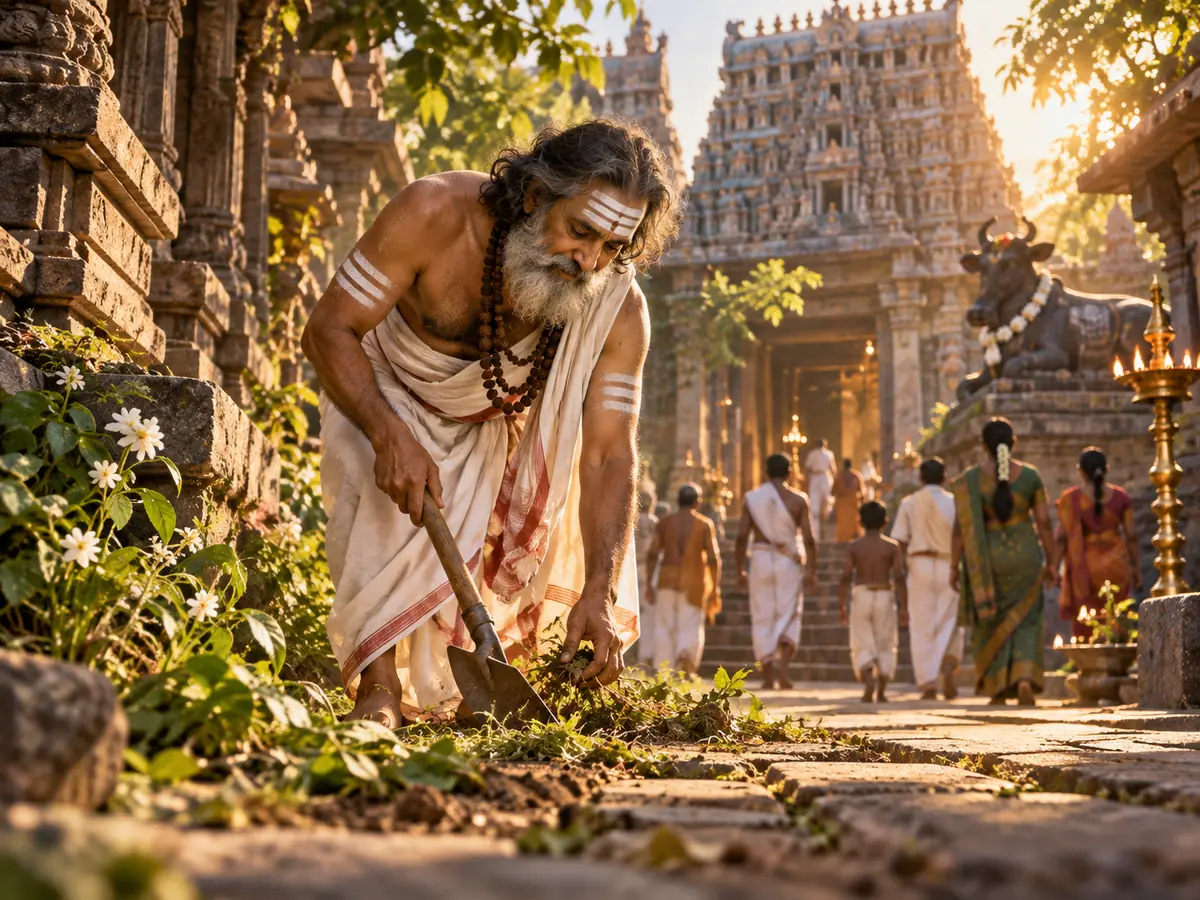
By the time the Periya Purāṇam tells the later years of , he is not an unknown man looking for a place in the world. He is Tirunāvukkaracar, a poet-saint whose hymns are sung in temples and whose name is carried from town to town.
That makes the object the hagiography keeps beside him more striking. It is not a sceptre, a manuscript or a musician's instrument. It is an uzhavaram: the kind of hoe used to cut weeds, loosen stubborn growth and clear temple ground.
At shrine after shrine, service means using his body as well as his voice. He can sing, and he can stoop. He can compose praise, and he can clear a path so someone else can walk through without stepping into thorns.
At Tiruppukalūr, Sēkkiḻār's saint-life sharpens that simple labour into a test. is working the ground when unusual things begin to appear among what his tool turns up.
There is gold. There are gems. What should have been stones and roots now includes objects that people cross cities to possess. The field has suddenly become the sort of place where a person might forget why he entered it.
The temptation does not need a voice. Every bright object makes its own argument: stop for a moment; pick me up; keep me apart; think what I could become in your hands.
But the Periya Purāṇam says does not change his task. He treats the precious things like the other obstructions in the soil. He removes them from the work in front of him rather than making the work serve them.
That detail is easy to turn into a slogan about money being bad. The story is more exact than that. is not running a market, feeding a family or deciding what wealth is worth in every circumstance. He is doing one chosen act of temple service, and wealth appears as the thing asking him to abandon it.
So he keeps going. The hoe rises and falls. Weeds come loose. Rough ground changes under repeated, ordinary effort. The jewels do not receive a ceremony simply because they are jewels.
The hagiography continues with further tests meant to pull his attention elsewhere. Those belong to the same saint-life logic: if gold will not turn him, perhaps some other attraction will.
But 's centre remains where it was. Service is not the impressive thing performed after every lesser task is finished. The lesser task itself can be the service.
That is why later memory so often pictures him with the uzhavaram. The tool says something the title poet-saint does not say by itself. He did not require devotion to look important before he would give himself to it.
His surviving Tēvāram hymns are the earlier textual witness to his devotional voice. The scene of gold and gems appearing while he clears the ground is the later Periya Purāṇam's hagiographic telling. Sandhya Katha keeps those layers distinct rather than pretending the miracle is recorded in his own songs.
The distinction does not weaken the image. It tells us what kind of truth the episode is offering: this is how the Tamil Śaiva tradition chose to show a saint whose attention could not be purchased away from the work he had taken up.
The field does not become less ordinary because treasure appears in it. The work still needs hands, patience and time. 's choice is repeated with every stroke: clear what blocks the path, leave the glitter where it belongs, and keep serving there.
Anyone can admire a jewel after noticing it. The saint-life asks a different question. Can a person notice exactly how valuable something is and still refuse to let that value rearrange every other commitment?
slow down hereIn a field suddenly glittering with things everyone would stop for, kept his hand on the small tool and finished the work he had come to do.